
Buildingo
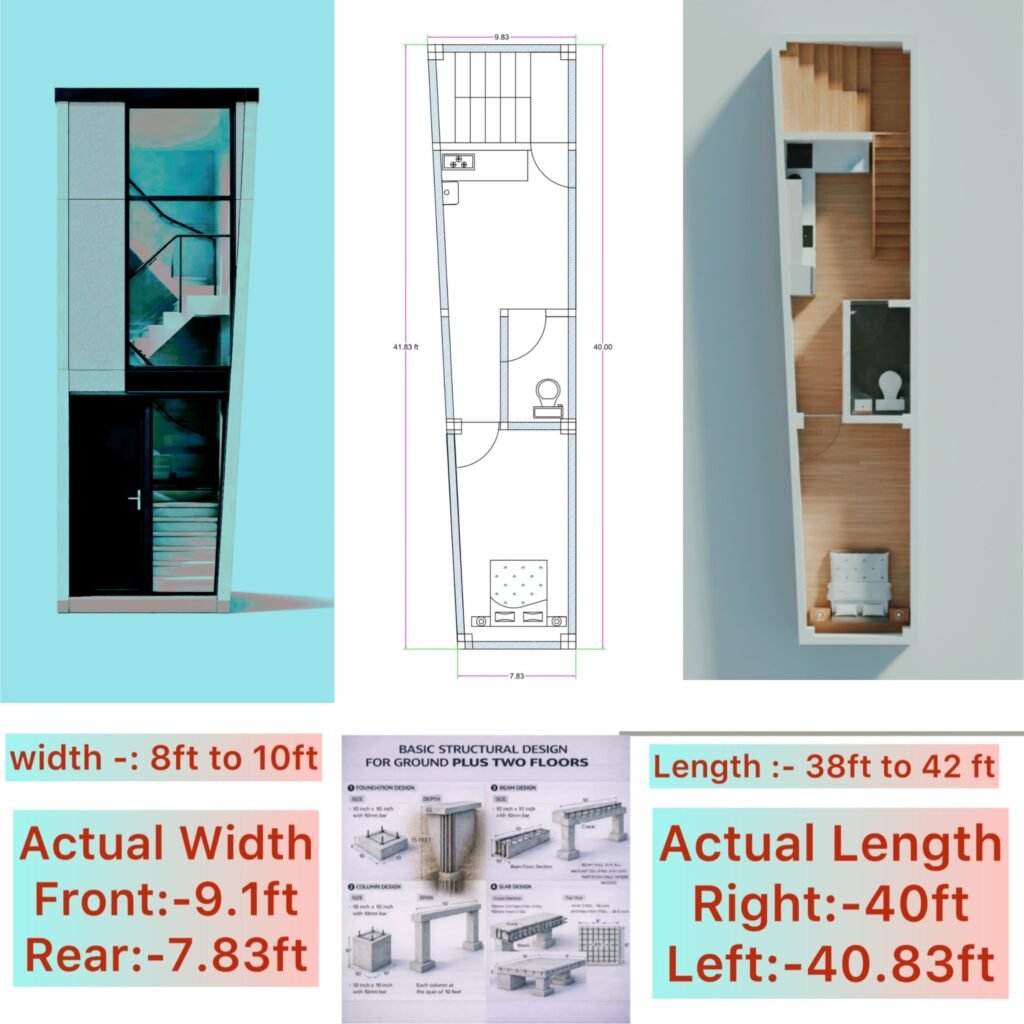
Designing a proper 1BHK house on a plot that is only 9.1 feet wide at the front and reduces to 7.83 feet at the rear, with a depth of 40 feet on one side and 40.83 feet on the other, is honestly not an easy task. This is not a regular rectangular plot. It is slightly trapezoidal, and that changes the whole approach of planning.
This design is developed specifically for this kind of narrow urban plot where land is limited but the requirement of a proper home still remains.
This is a ground floor 1BHK house, but structurally it is prepared in such a way that G+2 floors can be constructed in the future without modifying the foundation or structural grid.
Let’s understand the planning step by step.
Understanding the Plot Geometry
The plot is:
- 9.1 ft wide at the front
- 7.83 ft wide at the rear
- 40 ft deep on the right
- 40.83 ft deep on the left
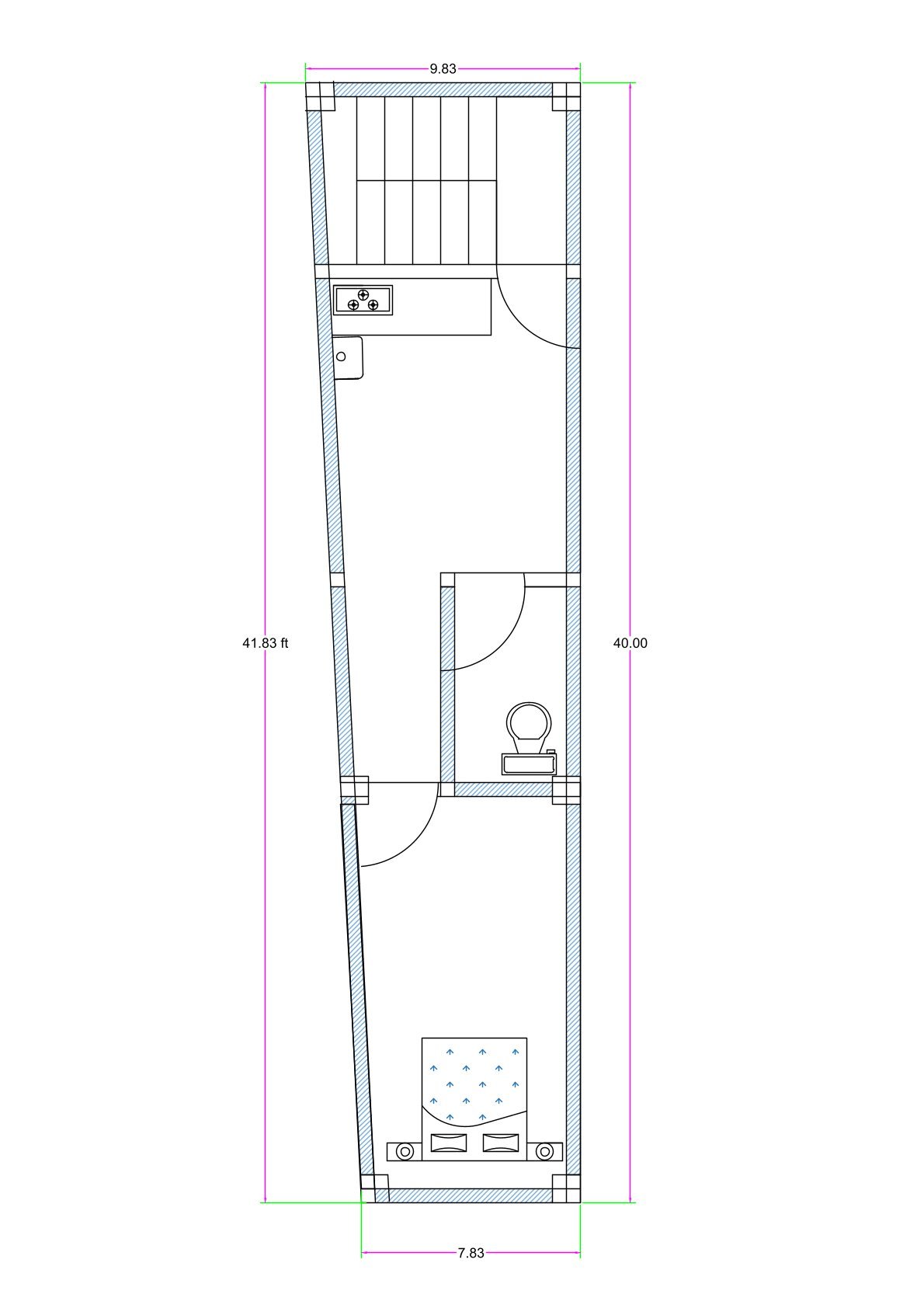
Because one side is slightly longer than the other, the side walls are not perfectly parallel. The rear becomes narrower by more than 1 foot compared to the front.
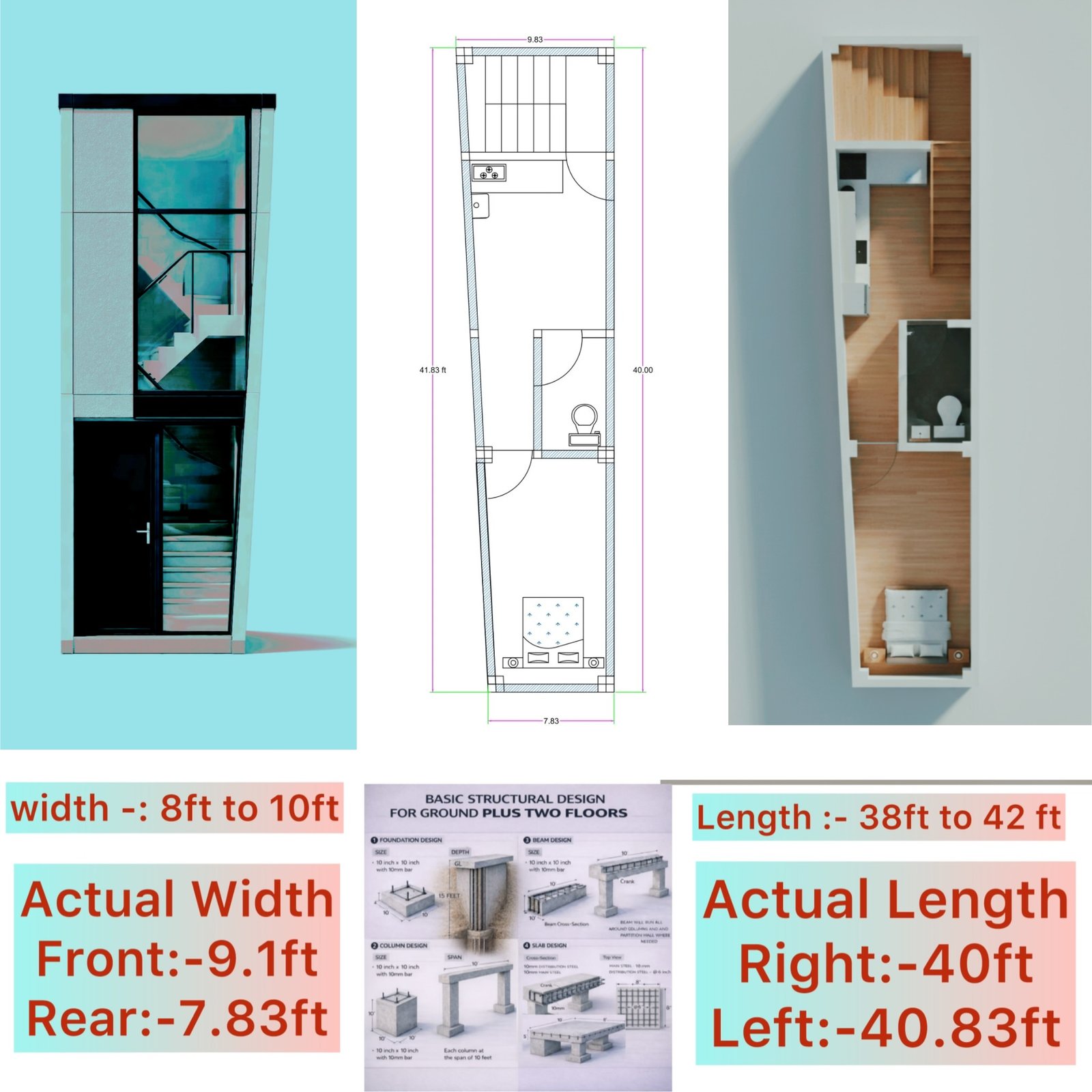
This tapering is clearly visible in the 2D drawing.
Instead of fighting against the plot shape, the internal layout follows the external boundary lines. This avoids awkward dead corners inside the rooms.
This compact layout is part of our full 10-drawing residential project.
Explore the master guide here → [Link]
Ground Floor Planning – 1BHK Layout
This design includes:
- One Hall
- One Kitchen
- One Bedroom
- One Toilet
- One Staircase
- Main Entrance
Everything is arranged in a linear flow because side-by-side planning is not possible in such width.
Entrance and Hall (Approx 15 ft x 8 ft)
As you enter from the 9.1 ft wide frontage, you step into an open hall area.
The hall is approximately 15 ft long and around 8 ft usable width. In such narrow houses, the hall becomes the most important space. It acts as:
- Living room
- Sitting space
- Sometimes dining space
To avoid congestion, furniture placement is kept along the walls. The trapezoidal nature of the plot actually helps slightly, because the front is wider, giving better entry comfort.
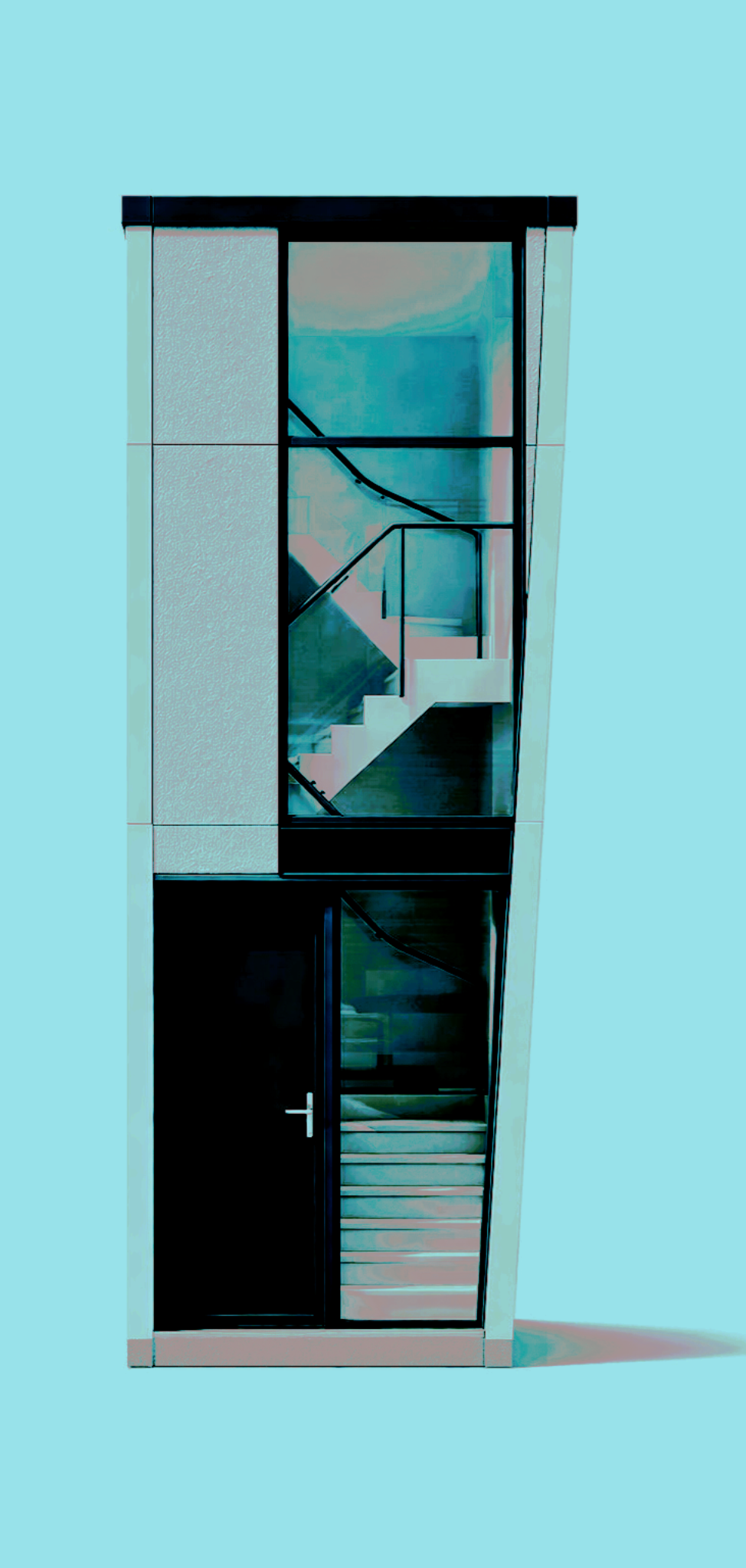
Natural light can enter from the front opening and from the staircase glazing (as shown in elevation).
Kitchen Placement (Near Staircase Zone)
The kitchen is placed toward the front-middle portion of the house, adjacent to the staircase block.
Because the width reduces as we move backward, keeping the kitchen closer to the wider front portion makes practical sense.
The kitchen counter is linear. In narrow homes, L-shaped counters eat up circulation space. A straight platform maintains movement flow.
Even though dimensions are compact, around 6–7 ft of counter length is achievable.
Toilet Block (Approx 4 ft x 7 ft)
The toilet is placed centrally along one side wall.
The size considered is around 4 ft x 7 ft, which is efficient for:
- WC
- Basin
- Shower space
Structurally and practically, this placement works well because:
- Plumbing lines can go vertically upward for future floors.
- It avoids cutting through major beam lines.
- It keeps wet areas stacked if upper floors are built.
Ventilation for the toilet can be managed through a vertical duct or small rear opening.
Bedroom at the Rear (Approx 10 ft x 8 ft or 12 ft x 8 ft)
The bedroom is positioned at the rear, where the width reduces to 7.83 ft.
Now, this is where planning becomes critical.
Even though the rear is narrower, a room of around 10 ft to 12 ft length and 8 ft width can comfortably fit:
- A queen-size bed
- Two side tables
- Wall-mounted storage
Placing the bedroom at the back ensures privacy from the entrance and street.
Because the plot narrows gradually, the internal walls are aligned carefully to maintain rectangular room proportions.
Staircase Block (Approx 10 ft x 8 ft Zone)
The staircase is positioned toward the front side of the layout.
It occupies roughly 10 ft length zone within the 40 ft depth.
Structurally, this is very important.
Even though the house is only ground floor at present, the staircase location allows independent vertical access when upper floors are constructed later.
The staircase also acts as a structural core, helping in load transfer and rigidity.
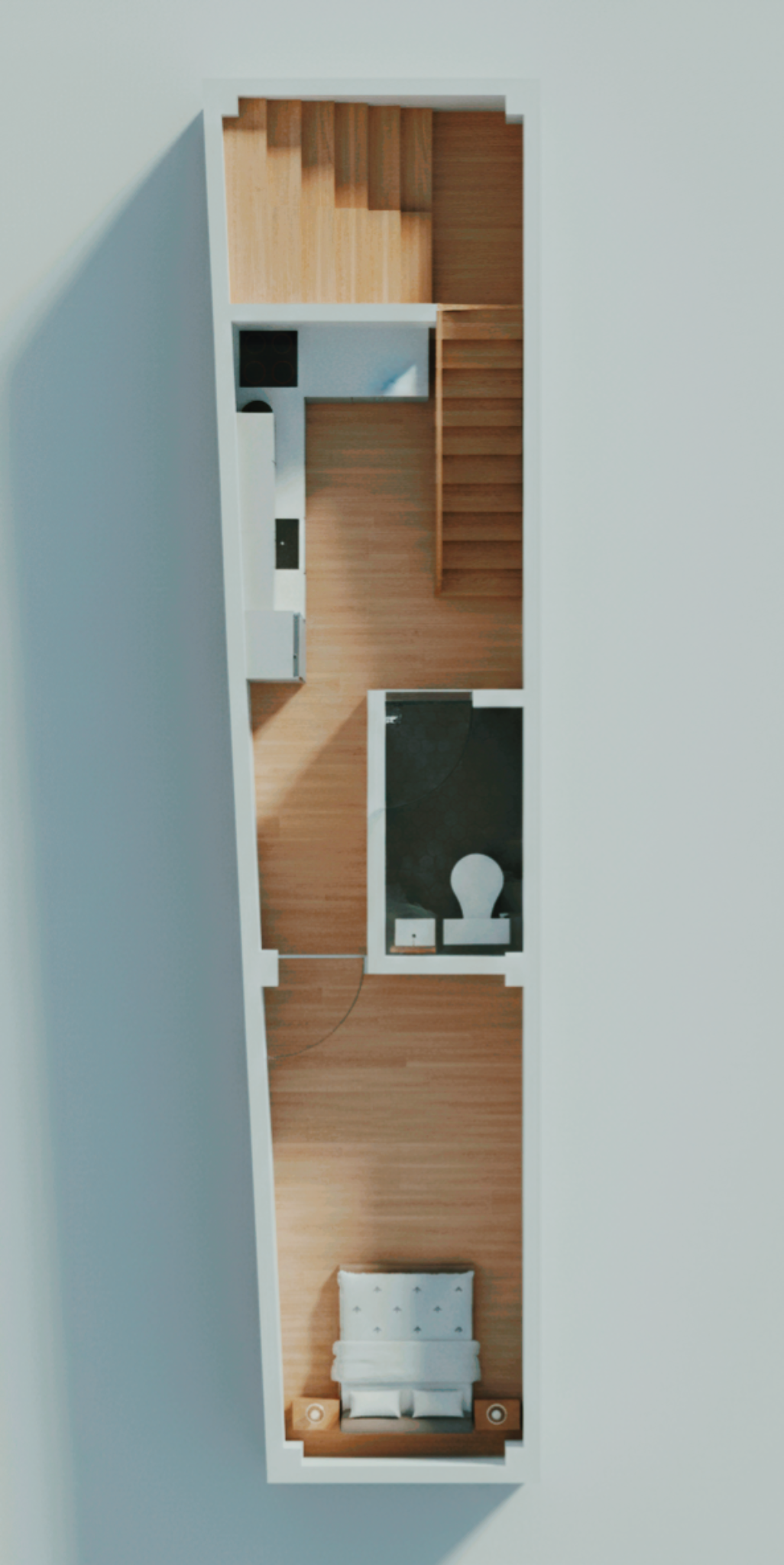
3D Floor Plan – Spatial Understanding
The 3D plan clearly shows how circulation works in a straight movement pattern:
Entrance → Hall → Kitchen & Toilet → Bedroom.
There is no unnecessary zig-zag movement. This is important in narrow houses, because too many turns reduce usable width.
The use of light flooring and minimal furniture enhances the perception of space.
Front Elevation – Modern and Vertical
The exterior elevation is completely different in style from conventional narrow houses.
It uses:
- Vertical glass panel for staircase
- Clean box frame structure
- Dark and light contrast tones
- Minimal projection
Since the front is only 9.1 ft, horizontal designs would look compressed. That is why vertical emphasis is used to make the building look taller.
The staircase glazing also improves daylight inside.
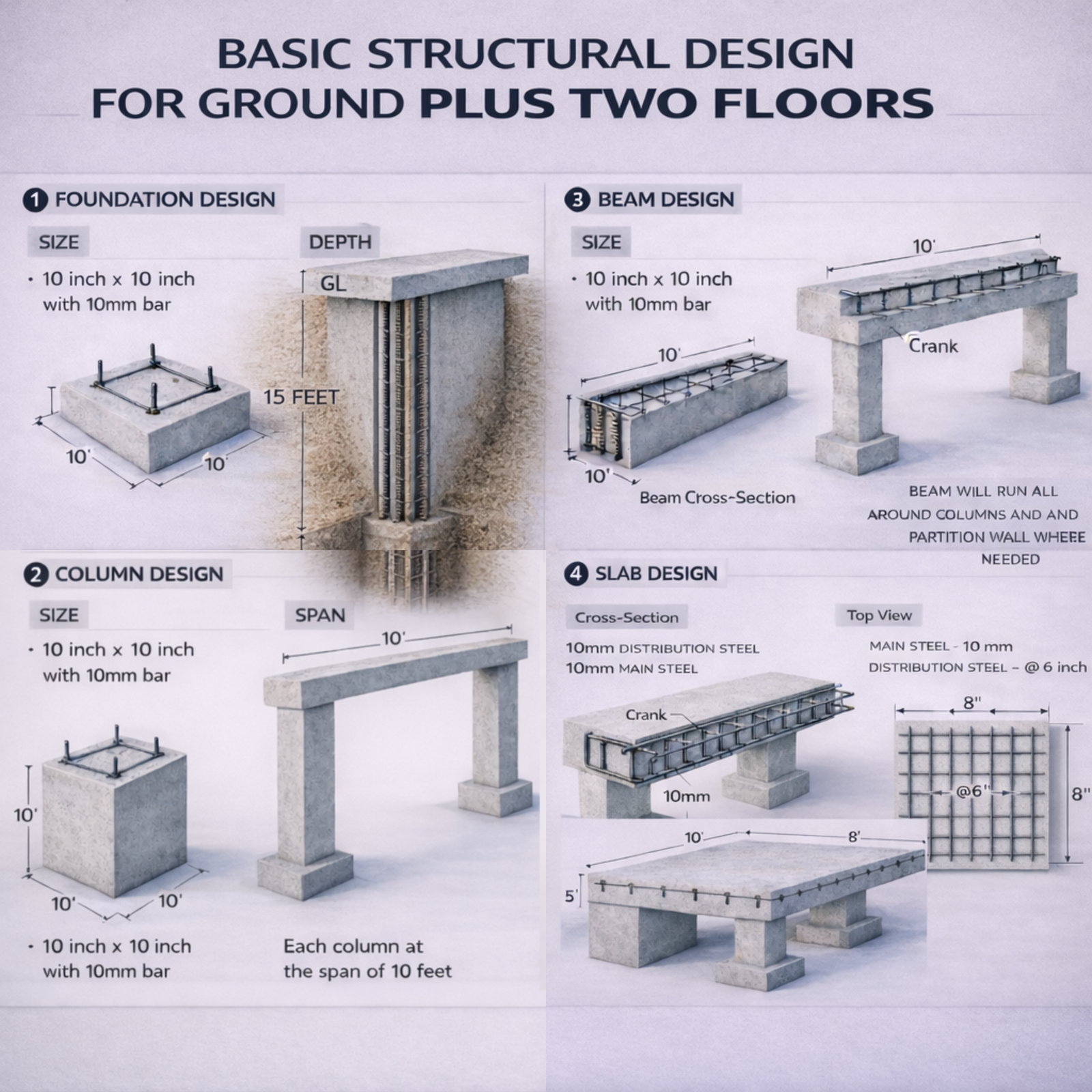
Structural Design – Ground Floor Now, G+2 Ready Later
Although this is currently a ground floor house, the structure is designed considering future expansion.
The structural system includes:
- Foundation: 10 inches x 10 inches column base going deep into soil.
- Columns: 10” x 10” RCC columns with 10 mm reinforcement.
- Beams: 10” x 10” beams around perimeter and under major walls.
- Slab: 4–5 inch thick RCC slab with 10 mm main steel and 8 mm distribution steel.
- Partition Walls: 5 inch thick.
Because the plot is narrow, load concentration is high. Maintaining uniform column size and vertical alignment ensures structural stability.
All columns are placed in such a way that if two more floors are added, no additional strengthening will be required.
Why This Design Works on This Exact Plot Size
On a plot that is:
- 9.1 ft front
- 7.83 ft rear
- 40 ft right
- 40.83 ft left
The key is linear zoning and structural discipline.
This design:
✔ Uses the wider front for entry and staircase
✔ Uses middle zone for services
✔ Uses rear for private bedroom
✔ Maintains structural alignment
✔ Keeps provision for future G+2
Final Thoughts
A trapezoidal 9-foot-wide plot may look restrictive on paper. But with correct proportioning and structural planning, it can become a practical and expandable home.
This is not just a ground floor 1BHK. It is a base structure designed for future growth.
Every drawing — the 2D plan, 3D floor visualization, elevation, structural layout, and combined presentation sheet — together explain how even a 9.1 ft narrow plot can support a well-planned residential unit.
Small frontage does not limit possibility. Planning decides everything.
See the first layout version here → [Link]
Read Hindi explanation here → [Link]