Buildingo
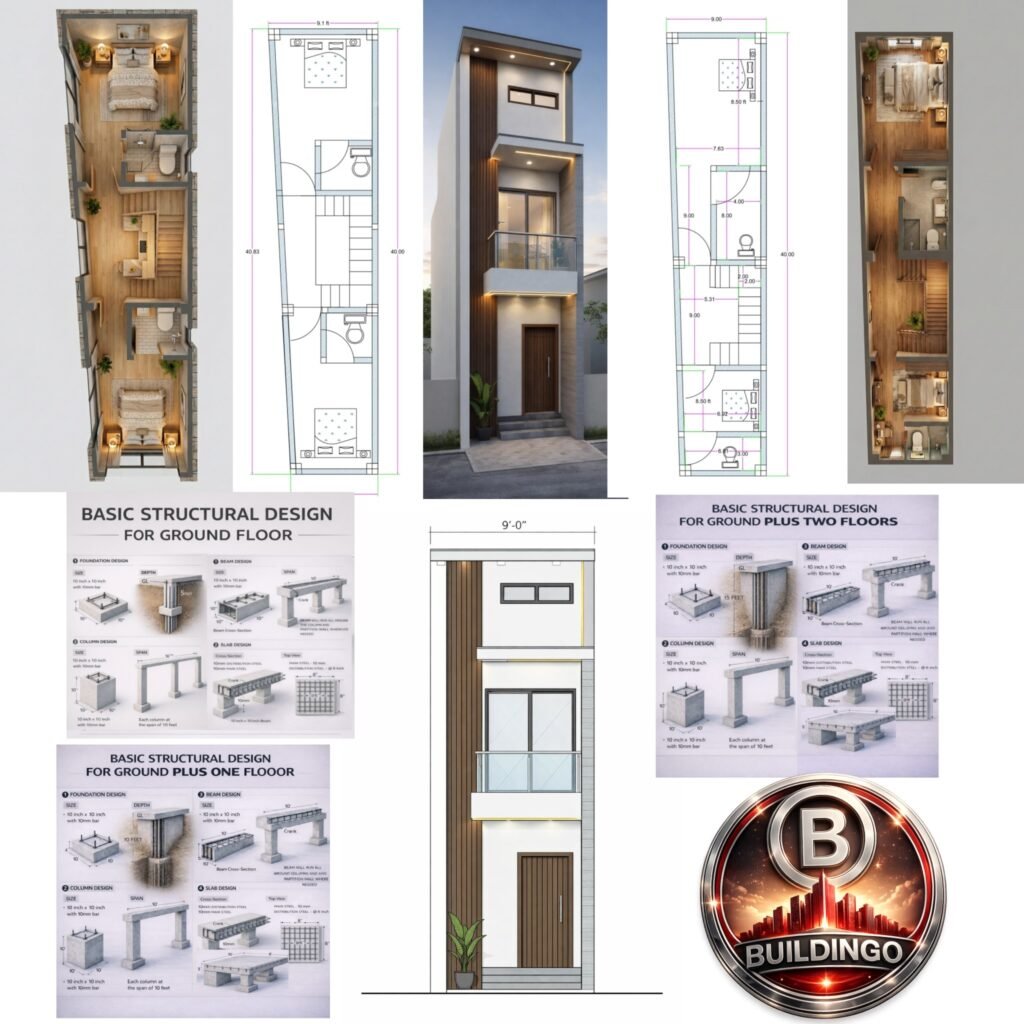
Case 1:- 15×20 Feet Narrow Plot 1BHK Design – 2D Plan, 3D floor plan, 3D elevation + Basic G+2 Structural Concept @ ₹99
Designing a house on a 15 feet wide and 20 feet deep plot is one of the biggest architectural challenges in modern urban India. With shrinking plot sizes and increasing land costs, narrow plots like 15×20 feet (300 sq ft per floor) are becoming extremely common in tier-2 and tier-3 cities.
In this blog, we are presenting a complete 1BHK solution including:
- 2D floor plan
- 3D Floor Plan
- 3D Front Elevation
- Basic G+2 structural design Concept
This design perfectly fits on a 15’ x 20’ plot and is suitable for G+2 construction with rental potential.
📐 Architectural Planning Concept (15×20 – 1BHK)
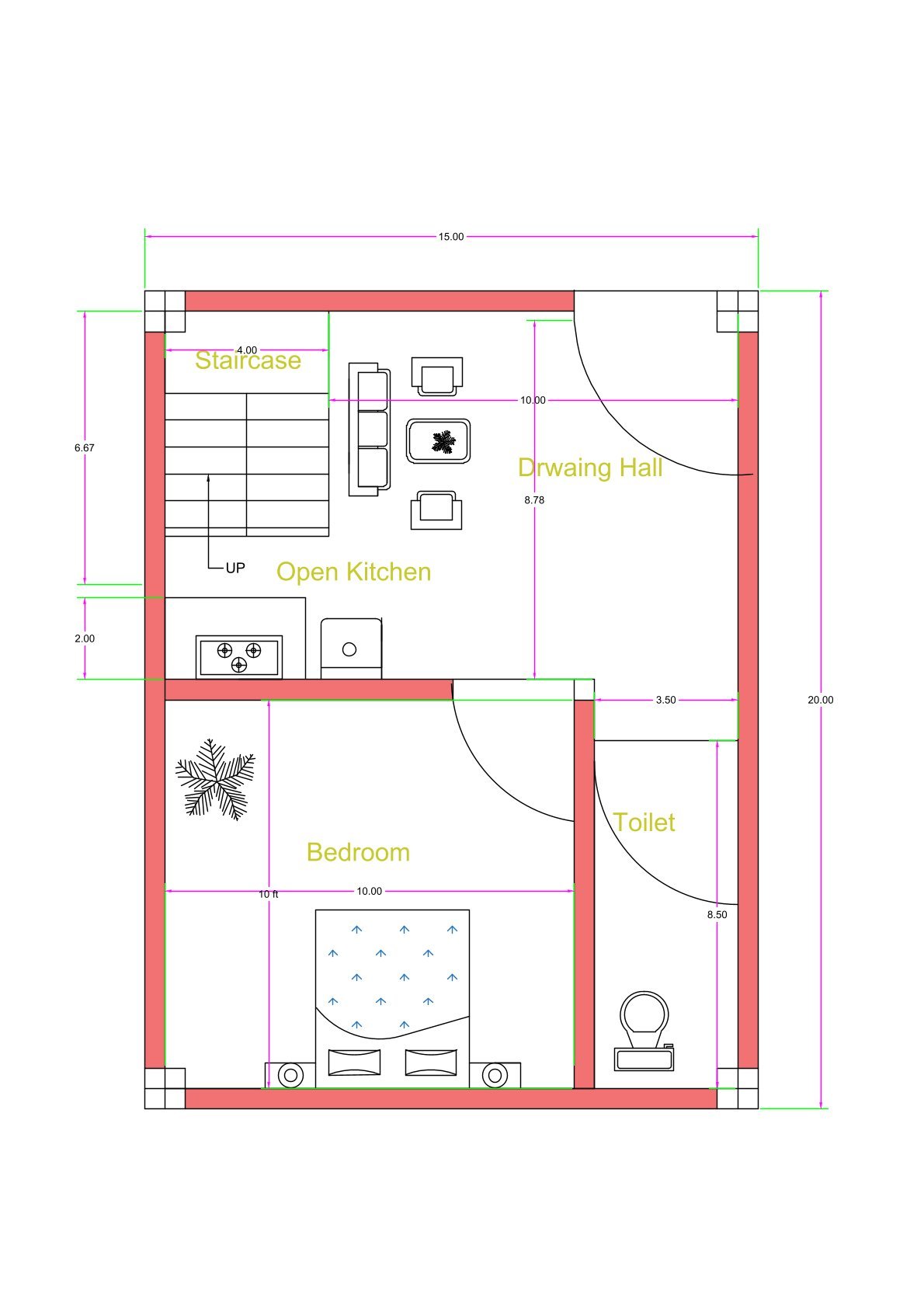
Despite the compact area, the internal planning ensures maximum space utilization.
Ground Floor Layout Concept:
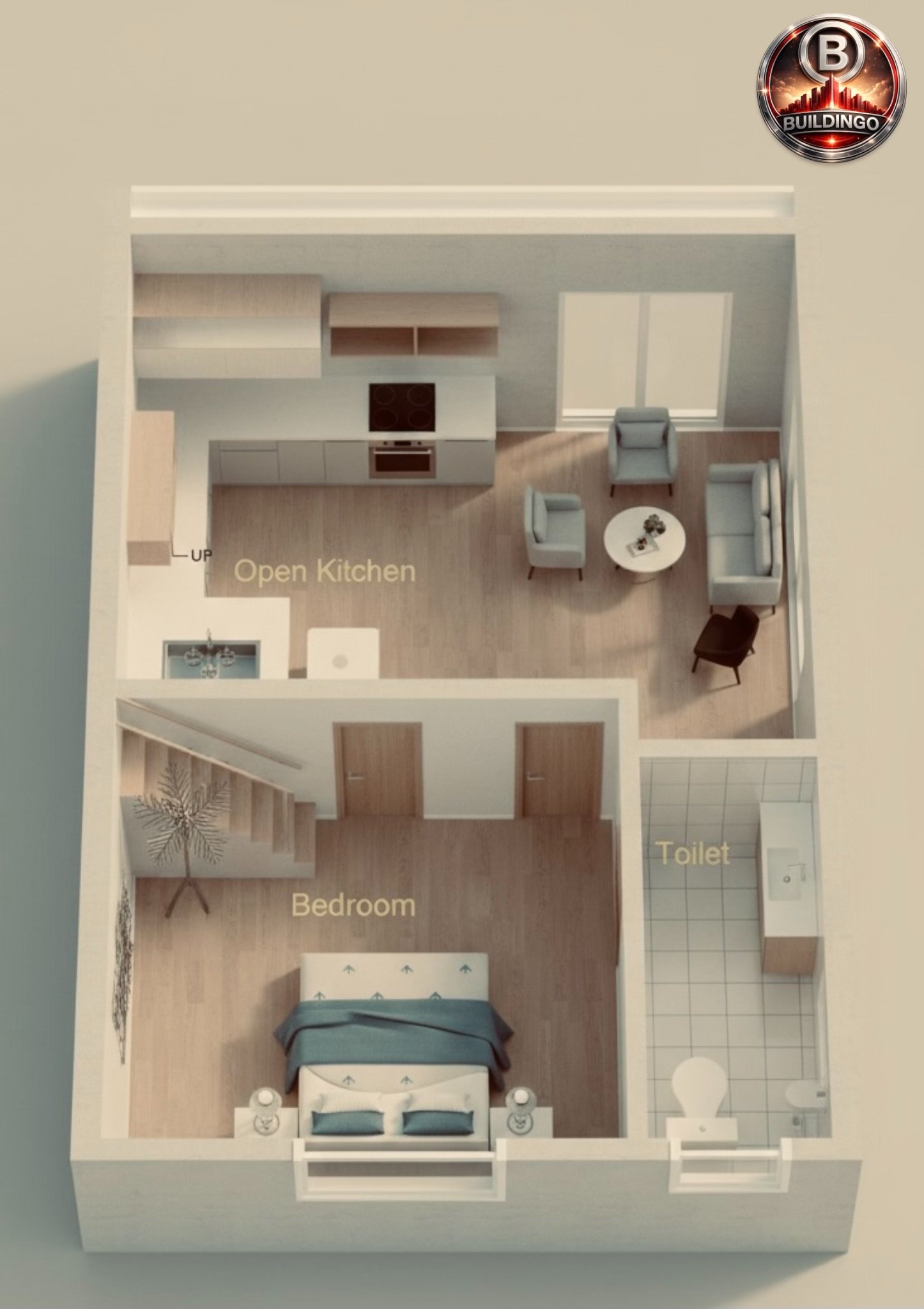
- Entry & Drawing Hall
- Approx. 10’ depth usable living area
- Compact seating arrangement
- Proper circulation space
- Natural ventilation from front opening
- Open Kitchen
- Designed beside staircase
- Open kitchen concept saves wall space
- Modern compact platform layout
- Suitable for nuclear family
- Staircase (4 feet width approx.)
- Positioned on one side
- Allows access to upper floors independently
- Ideal for future rental floors
- Efficient space planning under stair area
- Bedroom (10’ x approx. 10’)
- Standard double bed placement possible
- Wardrobe provision along wall
- Cross ventilation window provision
- Toilet (Approx. 3.5’–4’ x 8.5’)
- Combined toilet & bath
- Attached through lobby
- Compact but fully functional layout
This layout ensures:
- No dead space
- Maximum carpet utilization
- Proper movement flow
- Stair access for future G+2 expansion
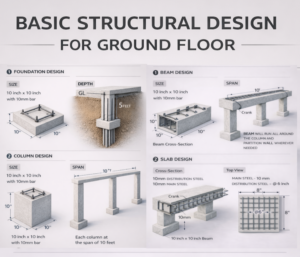
🏗 Basic Structural Design Concept (G+2 Safe Concept)
This design includes a basic structural framework suitable for G+2 construction across India.
⚠ Note: This is a conceptual structural system. Final structural design must be verified by local structural consultant based on soil test.
1️⃣ Foundation Design
- Pile Foundation Depth: 15 feet below ground level
- Suitable for weak to medium soil conditions
- Pile connected with plinth beam
- Pile cap integrated with column
Why pile?
Narrow plots often have load concentration. Pile foundation provides:
- Uniform load transfer
- Reduced settlement risk
- Long-term durability
2️⃣ Column Design
- Column Size: 10 inch x 10 inch
- Suitable for span approx. 10 feet
- Reinforcement:
- 4 to 6 main bars (12mm recommended minimum)
- Stirrups 8mm @ 6 inch c/c
This column size is economical and safe for G+2 when properly executed.
3️⃣ Plinth Beam
- Size: 10” x 10”
- Connected to all columns
- Acts as structural tie
- Prevents differential settlement
4️⃣ Beam Design (Roof & Lintel Beam)
- Size: 10” x 10”
- Above partition walls also beam provided
- Reinforcement:
- Main steel: 10mm – 12mm bars
- Stirrups: 8mm @ 6 inch c/c
Running beams over partition walls improves:
- Crack resistance
- Structural rigidity
- Long-term stability
5️⃣ Slab Design
- Slab Thickness: 4” to 5”
- Main Steel: 10mm
- Distribution Steel: 10mm
- Spacing: 6 inch center to center
- Alternate bar cut method can be applied
This slab configuration is strong for 10-foot span and suitable for G+2 residential loading.
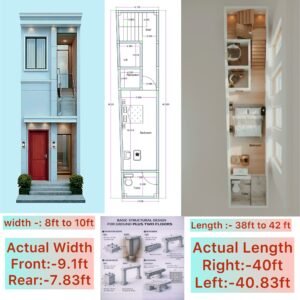
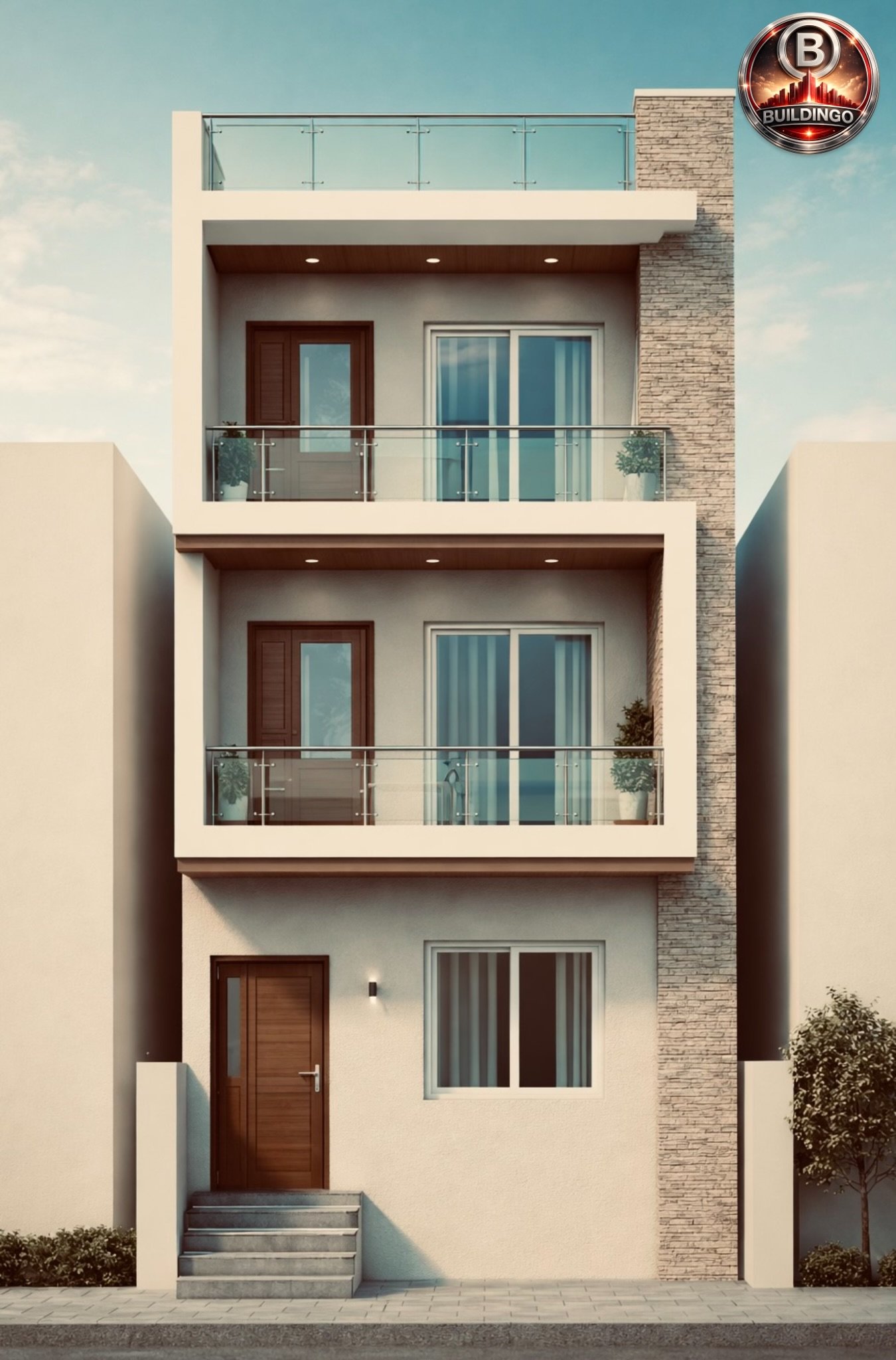
🏢 3D Elevation Concept
The elevation shown in the featured image represents:
- Modern minimal facade
- Balcony provision on upper floors
- Clean vertical stone cladding strip
- Glass railing balcony
- Ideal for narrow front look
This elevation style makes a small house look premium and modern.
💰 Why This 15×20 Plan is Ideal?
✔ Perfect for small investment
✔ Ideal for rental income (G+2 possibility)
✔ Compact but functional layout
✔ Structural concept included
✔ Suitable for urban narrow plots
✔ Stair access allows independent upper floors
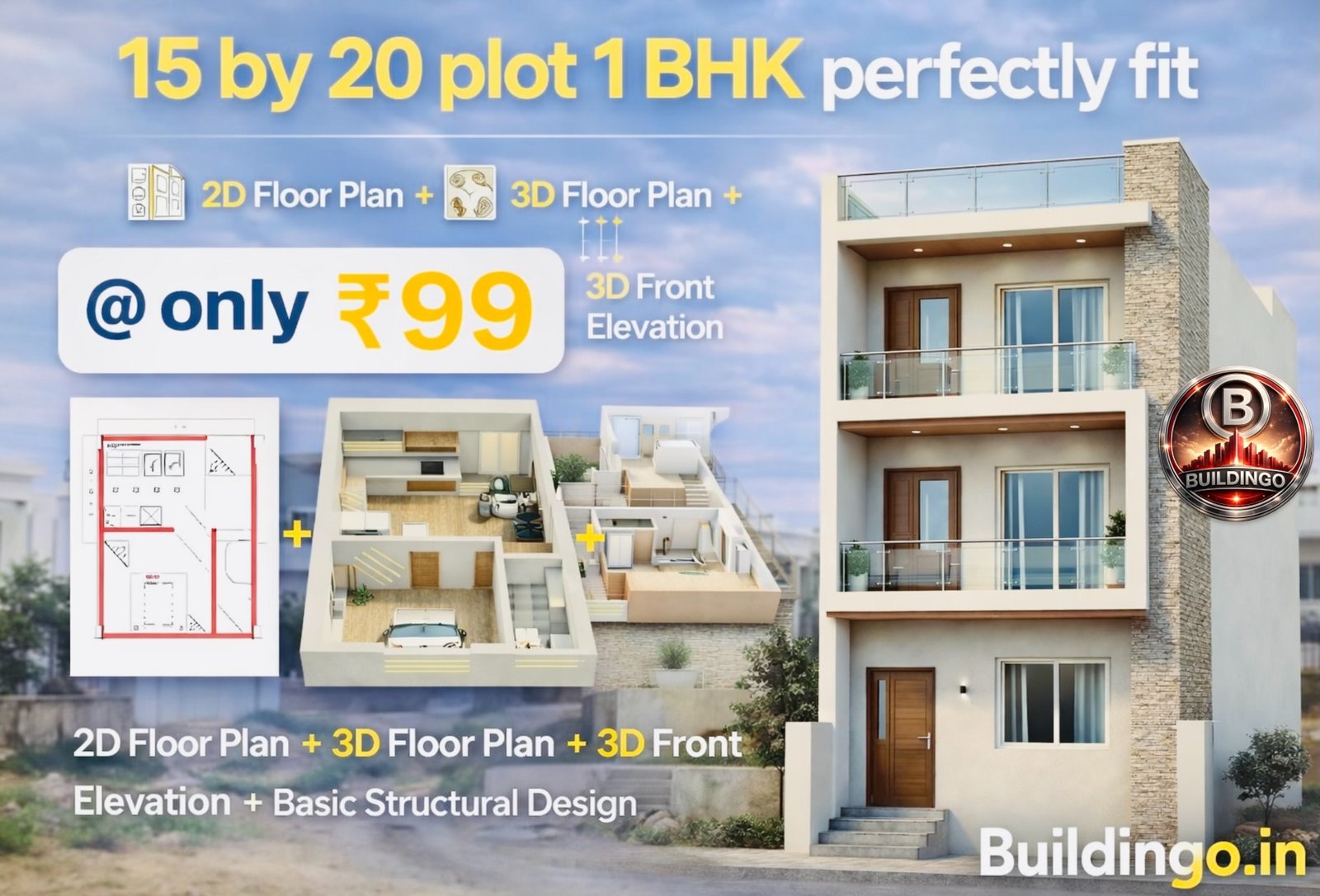
📦 What You Get in the Combo (₹99 Plan)
- 2D Floor Plan
- 3D Floor Plan
- 3D Front Elevation
- Basic Structural Layout Concept (G+2)
This combo is designed to help common people understand:
- Basic load transfer concept
- Structural logic
- Column & beam planning
- Safe construction approach
For detailed structural drawings with soil-specific calculations, professional consultation is recommended.
Conclusion
The 15 feet by 20 feet narrow plot may seem extremely small, but with intelligent planning and correct structural approach, it can become a safe and functional G+2 house.
This design proves that:
“Small plots do not limit dreams — poor planning does.”
15×30 Narrow Plot House Design (Actual Size: 15×27 Feet)
2BHK | 2D Floor Plan + 3D Floor Plan + 3D Elevation + Basic Structural Design @99
In today’s urban scenario, a 15-feet wide plot is one of the most common narrow plot sizes available in tier-2 and tier-3 Indian cities. This design is prepared for a 15 feet wide × 27 feet deep plot (actual size), and for search and standard usability (SEU), it can be considered under the popular 15×30 plot category.
This plan demonstrates how a compact yet highly functional 2BHK layout can be achieved within limited width while maintaining proper circulation, ventilation, structural stability, and architectural balance for a G+2 building configuration.
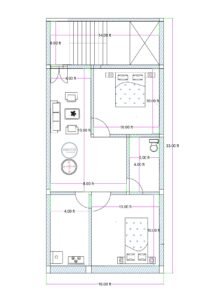
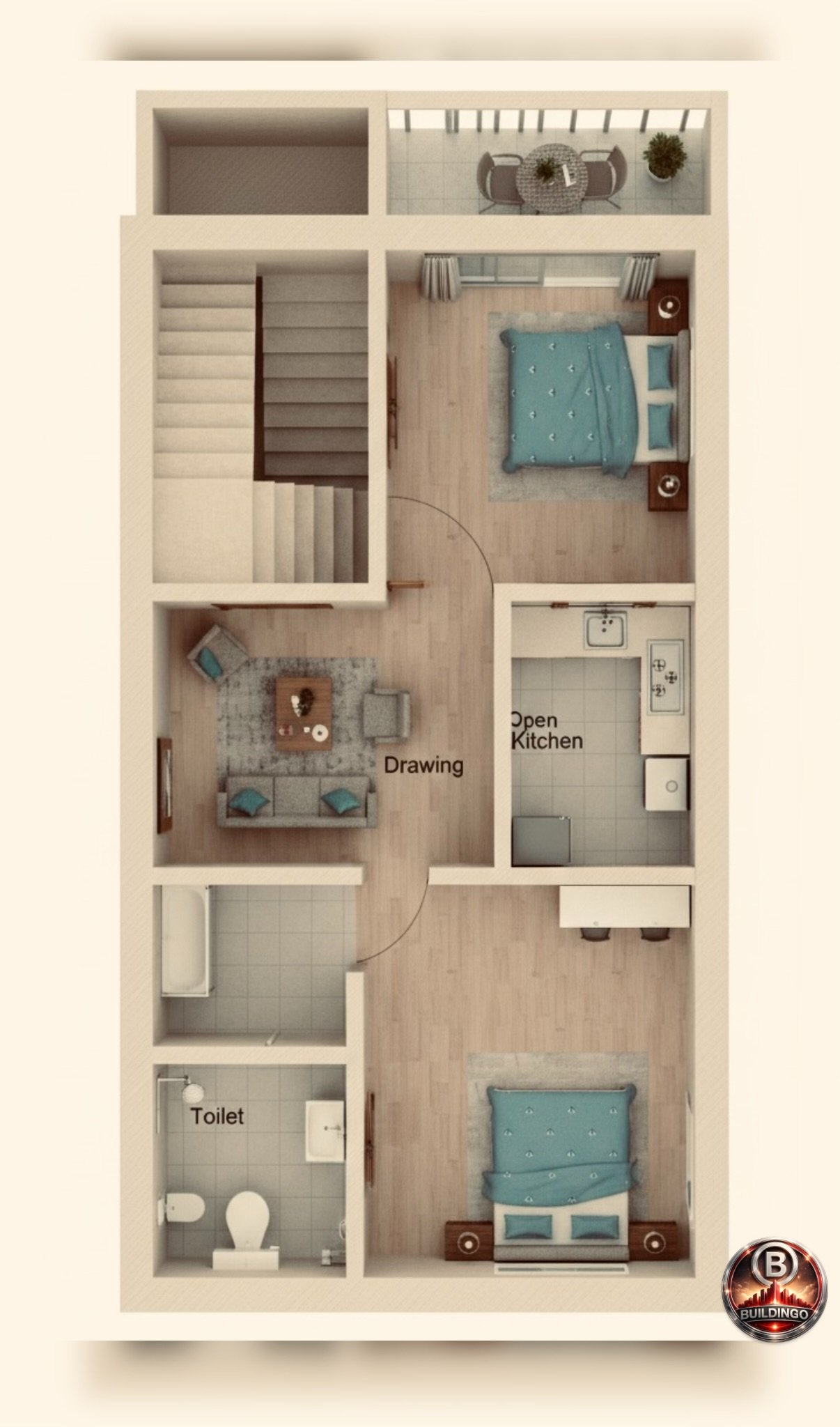
1. Architectural Planning Concept (15×27 Actual Plot)
Ground / Typical Floor Layout
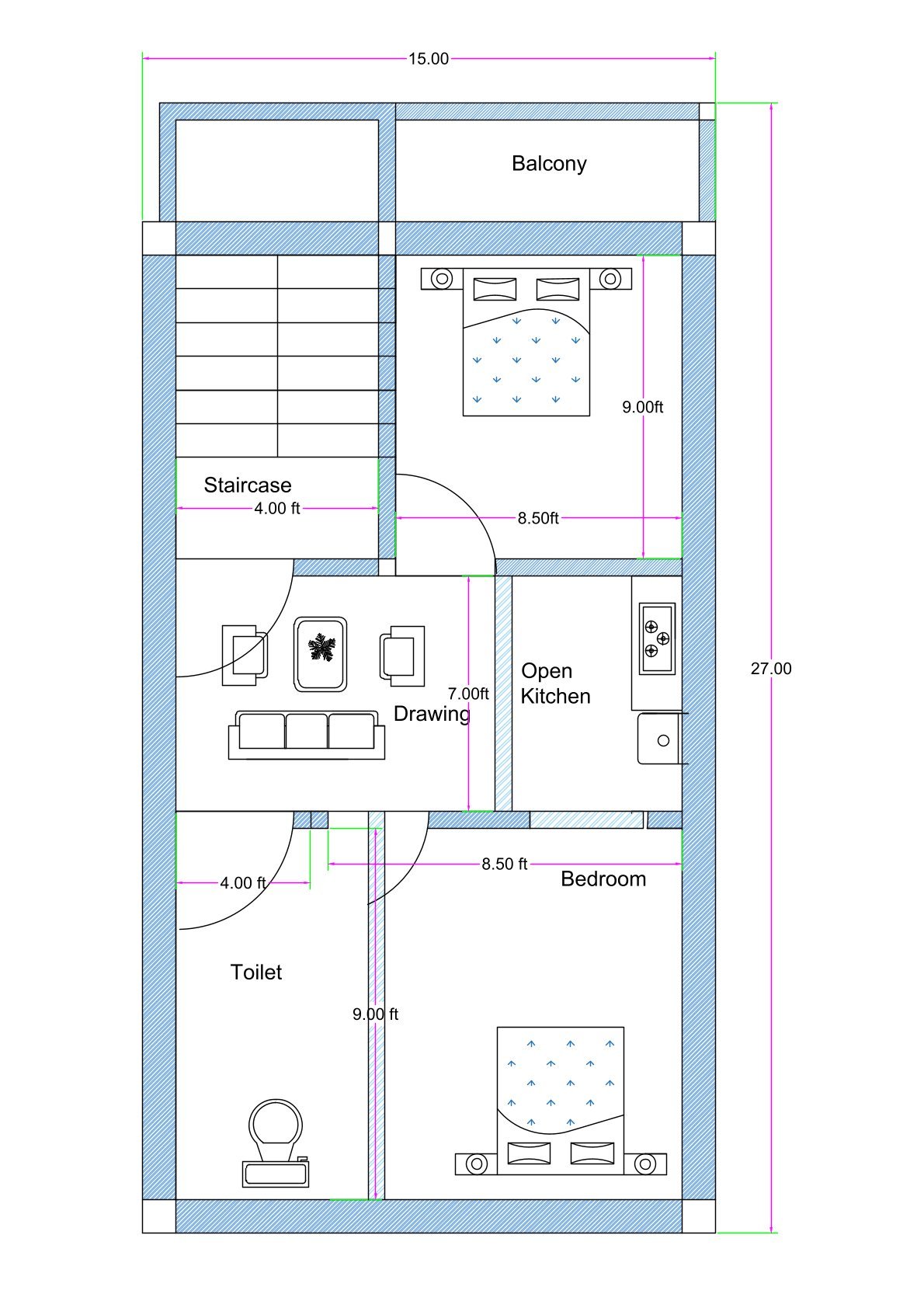
The plan efficiently accommodates:
Front Balcony
Staircase (4 ft wide)
Drawing Room (approx. 7 ft width usable)
Open Kitchen
Two Bedrooms
Common Toilet
Rear Ventilation / Balcony Space
Entry & Circulation
Entry is planned from the front, where a balcony provides both aesthetic value and weather protection. Immediately adjacent is the 4-feet wide staircase, which ensures comfortable vertical movement for a G+2 structure. The staircase is positioned intelligently to maintain privacy between public (drawing) and private (bedroom) spaces.
The drawing room is centrally placed, acting as the distribution space toward:
Kitchen (side aligned for plumbing efficiency)
Bedroom 1 (rear side)
Bedroom 2 (upper side near balcony)
Common toilet
This ensures zero dead space and optimized movement within just 15 feet of width.
2. Space Optimization in a 15-Feet Wide Plot
Designing within 15 feet requires careful planning:
A. Bedrooms
Approx. 8.5 ft × 9 ft and similar proportioned bedrooms
Proper window placement for cross ventilation
Furniture layout pre-considered to avoid congestion
B. Open Kitchen Concept
The open kitchen increases visual width perception. Instead of blocking walls, a semi-open layout ensures:
Natural light flow
Visual continuity
Reduced structural load walls
C. Common Toilet Placement
The toilet is positioned to share plumbing lines vertically for G+2 efficiency. This reduces:
Pipe length
Maintenance complexity
Future leakage risks
3. 3D Floor Plan & Elevation Concept
The 3D floor plan clearly visualizes:
Furniture placement
Movement flow
Staircase headroom
Balcony usability
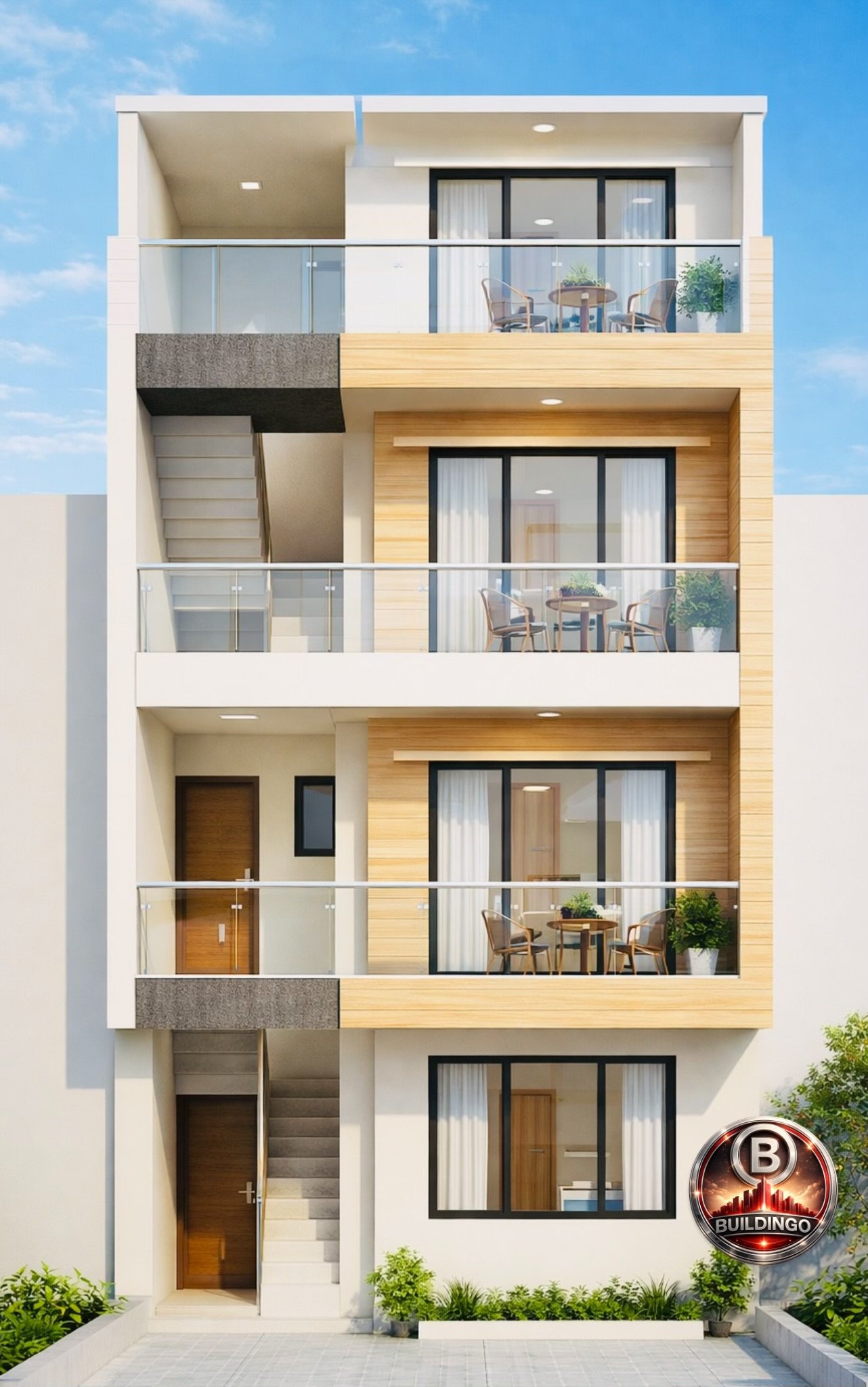
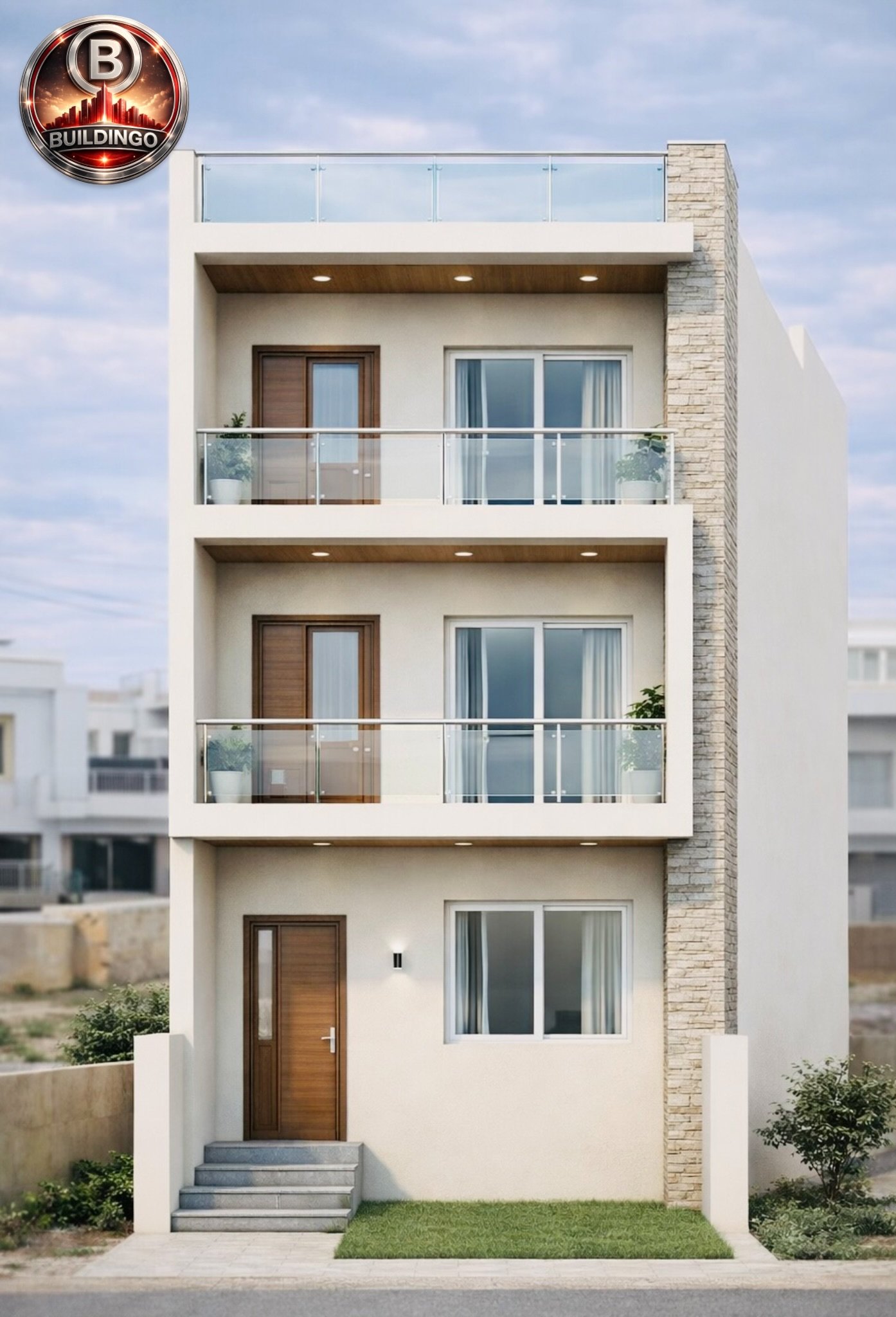
The 3D front elevation reflects a modern narrow-plot façade:
Clean rectangular geometry
Balcony glass railing
Wooden texture panels
Vertical stone finish element
Proper sunshade projection
Because the plot is only 15 feet wide, vertical elevation design becomes critical. The façade emphasizes height and proportion, making the building look elegant rather than congested.
4. Basic Structural Design (G+2 – Standardized for All Narrow Plots)
This design includes a basic structural concept, engineered for safety across most normal soil conditions in India.
Note: This is a concept-level safe design. For site-specific soil conditions, a local structural consultant must be engaged.
Foundation
Pile foundation depth: 15 feet below ground level
Each pile connected to plinth beam
Suitable for G+2 load bearing
Plinth Beam
Size: 10″ × 10″
Reinforcement: 10–12 mm main bars
Designed to tie all columns together
Column Design
Size: 10″ × 10″
Suitable for 10 feet span
Designed for G+2 loading
Continuity from foundation to roof
Beam Design
Size: 10″ × 10″
Above every partition wall beam provided
Main reinforcement: 10–12 mm bars
Stirrups as per standard spacing norms
Slab Design
Thickness: 4″ to 5″
Main steel: 10 mm
Distribution steel: 10 mm
Spacing: 6 inches center to center
Alternate bar cutting practice followed
This uniform structural module ensures:
Simplicity in execution
Reduced construction error
Material optimization
Cost efficiency
5. Engineering Advantages of This 15×27 (15×30 SEU) Plan
✔ Perfect for rental G+2 configuration
✔ Standardized column grid
✔ Plumbing alignment floor-to-floor
✔ Minimal beam complexity
✔ Proper ventilation provision
✔ Compact yet livable 2BHK
6. Why This Plan Works for Narrow Plots
In narrow plots, the main challenges are:
Lack of cross ventilation
Congested staircase placement
Structural misalignment
Wasted passage areas
This plan resolves these issues through:
Side-aligned staircase
Open kitchen concept
Straight load transfer path
Balanced room proportions
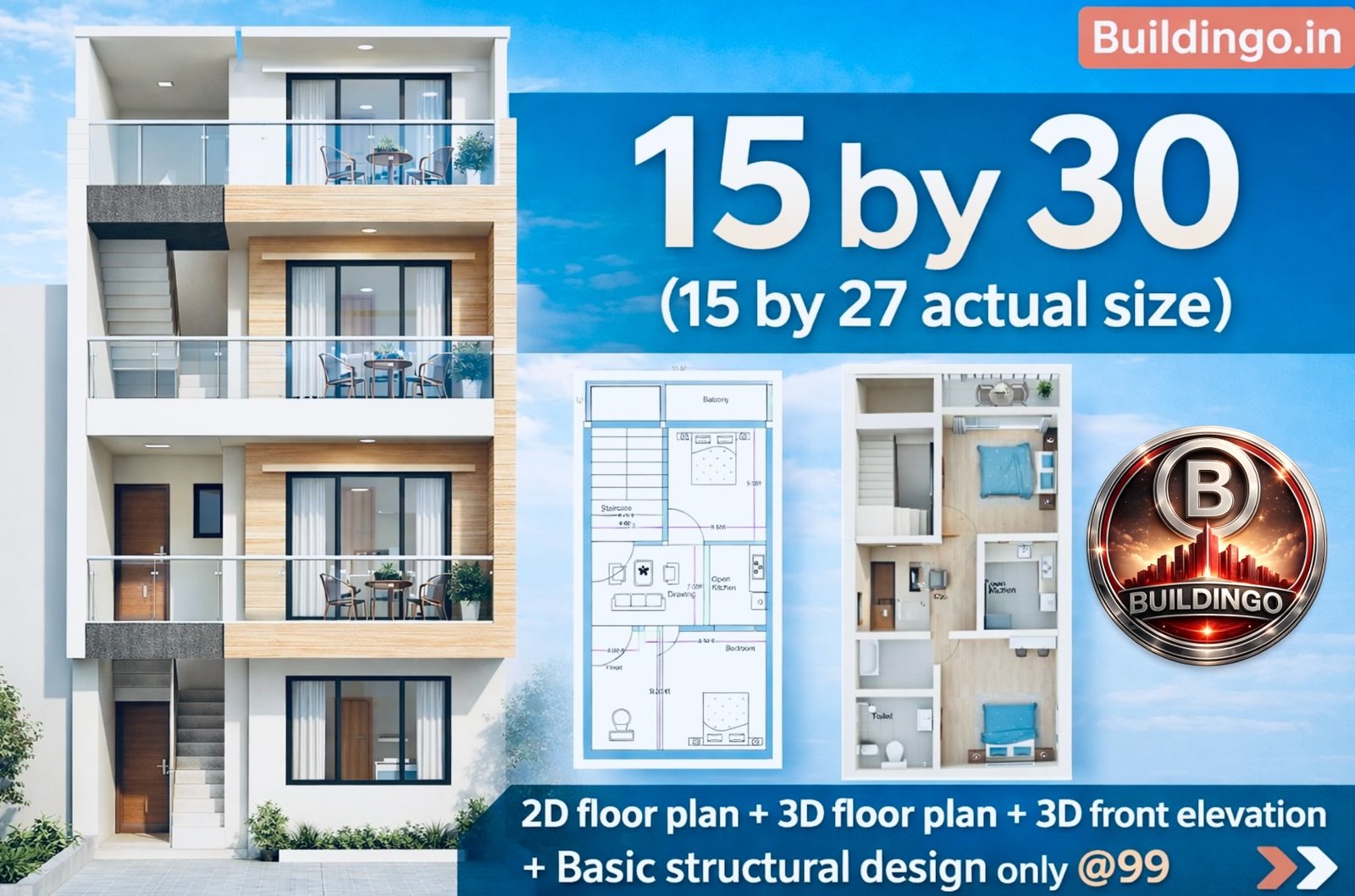
7. What You Get in the Combo @99
2D Floor Plan
3D Floor Plan
3D Front Elevation
Basic Structural Design Concept (G+2 Ready)
This makes it a complete starter solution for small investors, rental property builders, and first-time homeowners.
Final Conclusion
The 15×27 feet (considered 15×30 for SEU) narrow plot design proves that limited width does not mean limited lifestyle. With proper structural planning, architectural optimization, and standardized beam-column sizing, a compact 2BHK G+2 house can be built safely and efficiently.
This is an ideal solution for:
Urban narrow plots
Budget housing
Rental investments
Compact family homes
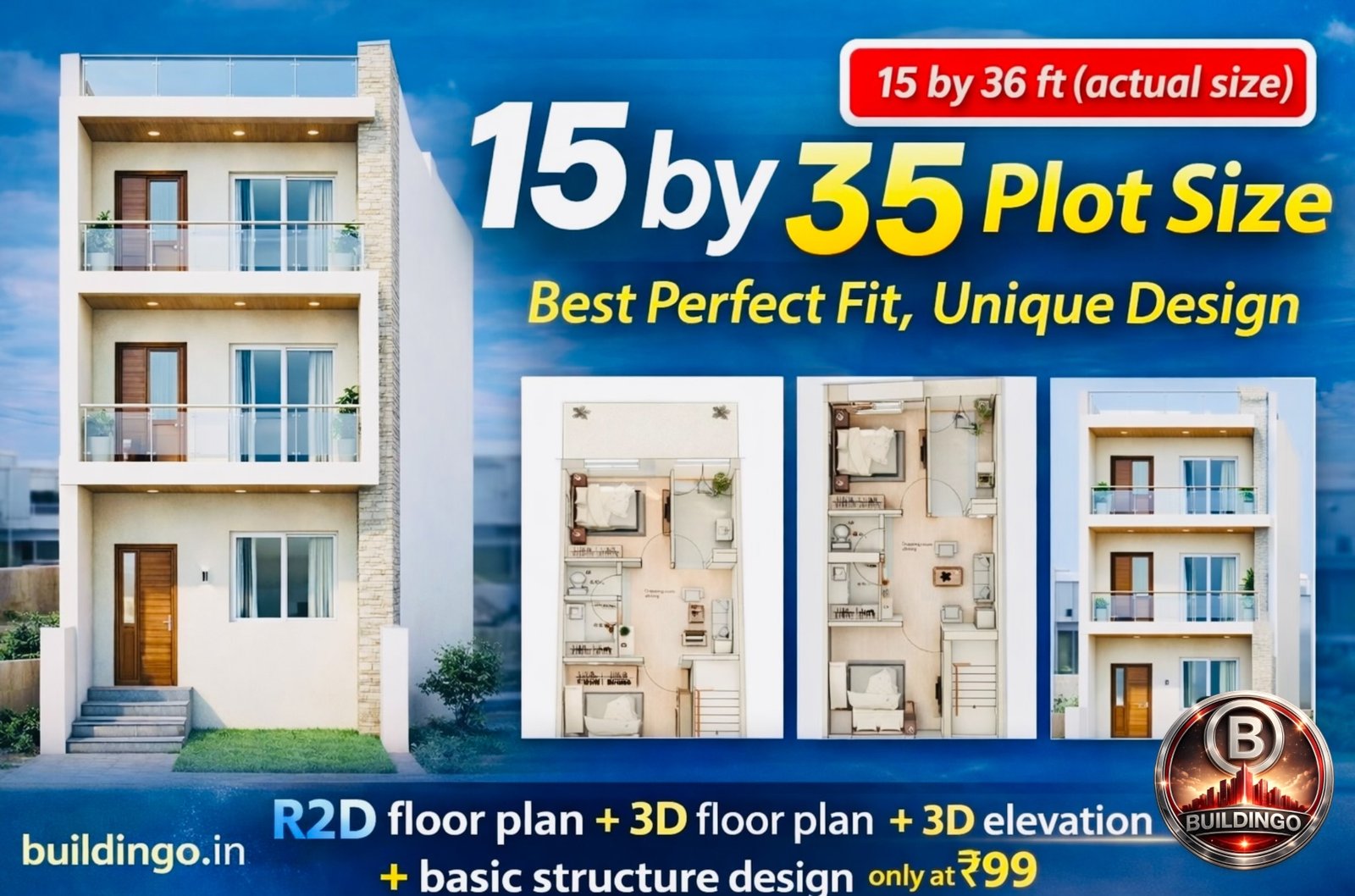
15×36 Narrow Plot House Design (Actual Plot Size 15×42 | Built-up 15×36) – 2BHK G+2 Complete Plan with Basic Structural Concept
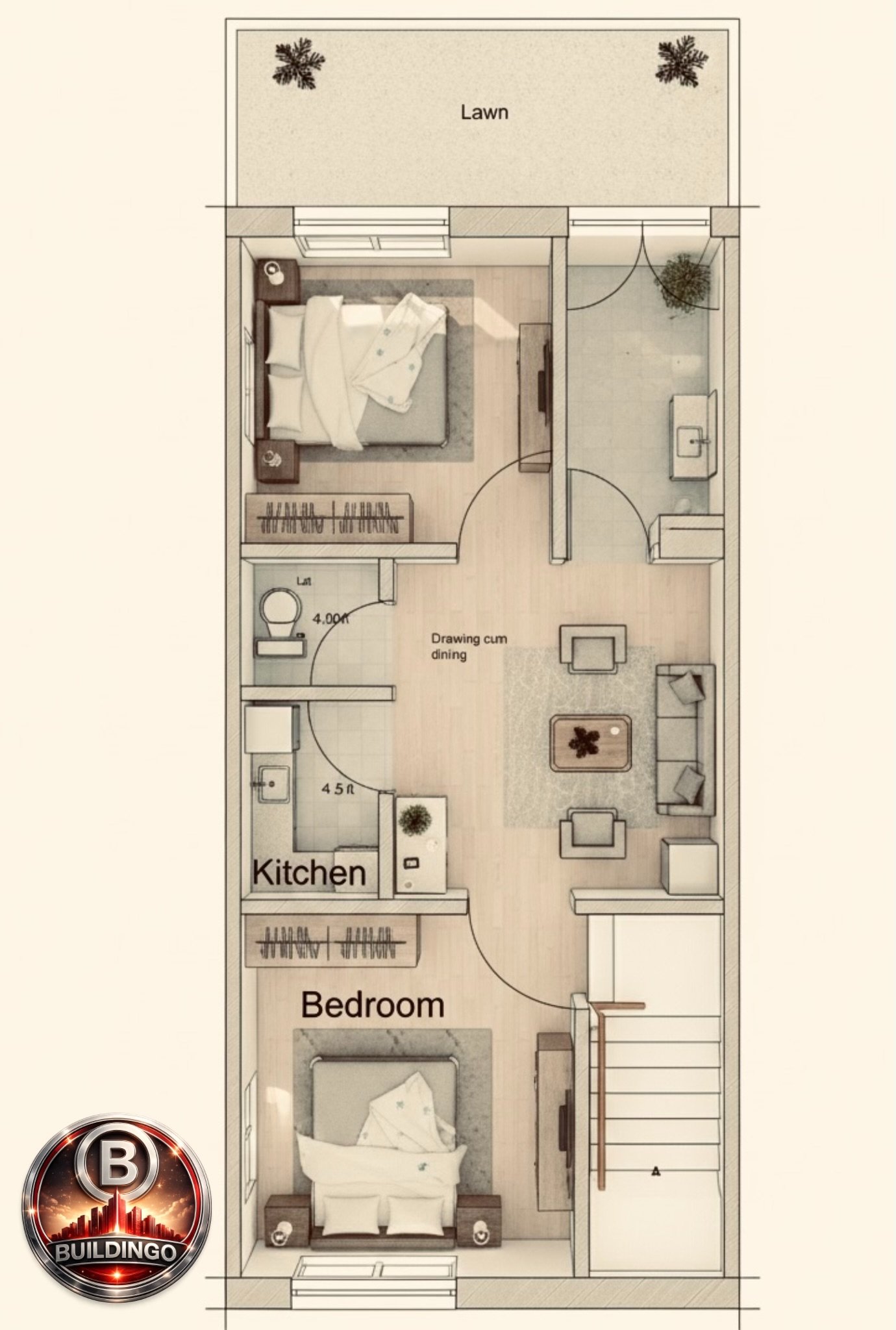
In this third narrow plot series, we are discussing a 15 feet wide and 42 feet deep plot, where the effective built-up area has been smartly planned as 15×36 feet, leaving the remaining front or rear portion for ventilation, setback, or future flexibility. For SEO and standard classification, this design also perfectly fits into the 15×35 to 15×40 narrow plot category, but the actual constructed planning here is 15×36 within a 15×42 site.
This compact yet highly functional 2BHK layout is designed for G+2 structure, following the same structural philosophy we discussed earlier — safe, practical, and conceptually strong across Indian soil conditions.
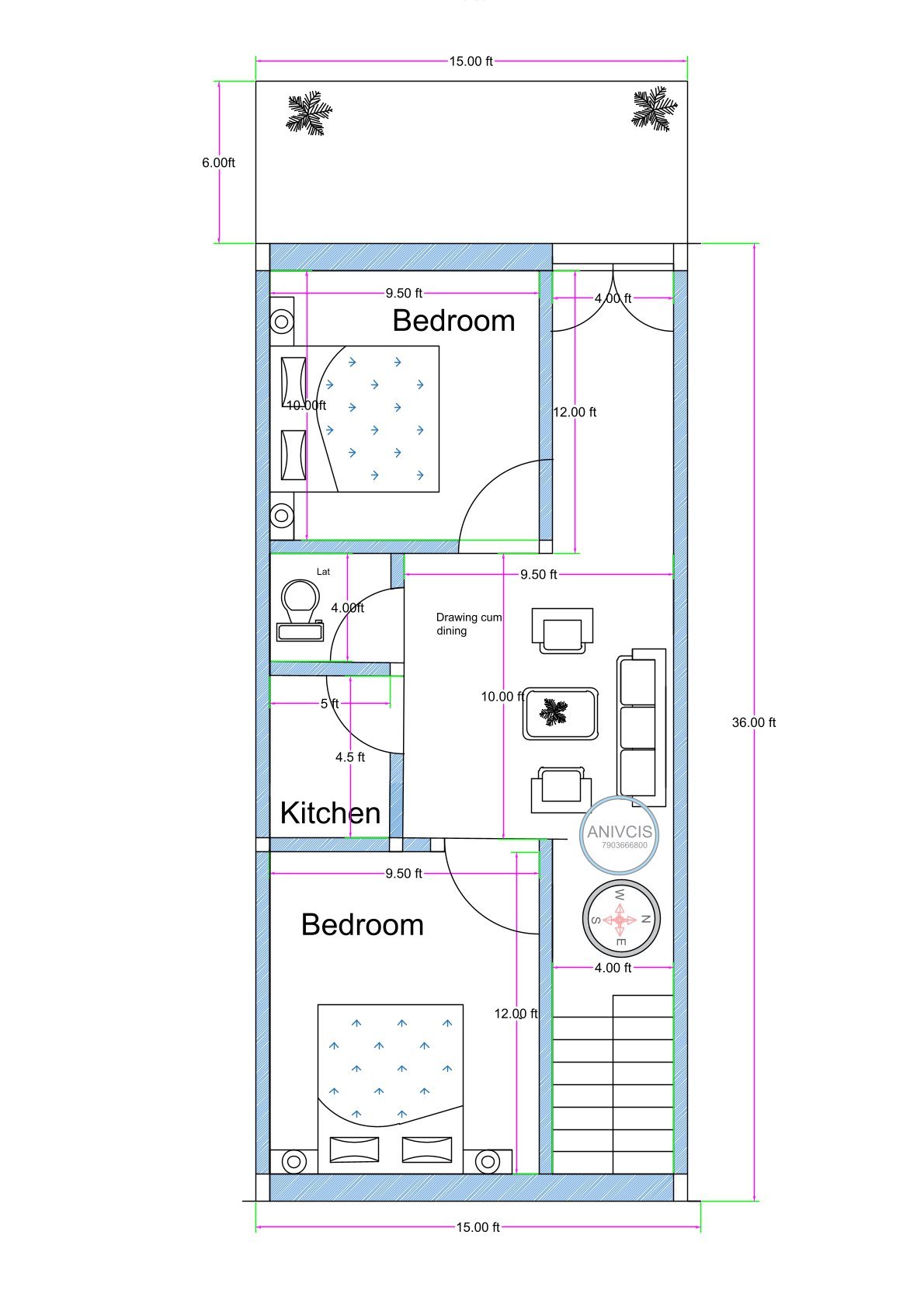
Architectural Planning Concept – 15×36 Built-Up Area
1️⃣ Front Bedroom with Lawn / Open Space Connection
At the front portion of the built-up zone, a well-ventilated bedroom (approx. 9.5’ x 12’) has been provided. Because the total plot depth is 42 feet and built-up is 36 feet, a 6-foot front open lawn / setback improves:
Natural light penetration
Cross ventilation
Thermal comfort
Privacy buffer from road
This bedroom can function as a master bedroom or guest bedroom depending on family needs.
2️⃣ Central Drawing Cum Dining (Space Optimization)
Moving inward, we reach the drawing cum dining space (approx. 9.5’ x 10’).
This central placement ensures:
Direct connectivity to kitchen
Easy access to both bedrooms
Efficient circulation without wasted lobby space
For narrow plots, eliminating unnecessary corridors is essential. Here, every square foot is functionally utilized.
3️⃣ Kitchen Placement (Logical & Practical)
The kitchen is placed along one side wall, near the central zone.
Approx. dimensions: 5’ to 6’ width with adequate platform length.
This positioning ensures:
Plumbing alignment with toilet wall (cost efficiency)
Good structural beam alignment
Proper exhaust provision toward side setback
In narrow houses, stacking wet areas vertically for G+2 construction significantly reduces plumbing complexity.
4️⃣ Common Toilet (4’ Width Efficient Layout)
A compact yet comfortable 4’ wide toilet block is provided adjacent to kitchen and living area.
This allows:
Easy plumbing shaft continuity
Structural beam integration
Reduced pipe bending and leakage risks
5️⃣ Rear Bedroom + Staircase at Back
At the rear portion:
One additional bedroom (approx. 9.5’ x 12’)
Staircase positioned at back corner
The staircase placement at rear ensures:
Privacy separation
Independent upper floor access
Future rental flexibility
This planning supports:
✔ Owner occupancy on one floor
✔ Rental income from upper floors
✔ Duplex possibility in future
Structural Engineering Concept – G+2 Safe Basic Model
Now let us discuss the structural philosophy that remains constant across all narrow plot models in this series.
🔹 Foundation
Pile foundation depth: 15 feet below ground level
Designed for typical Indian SBC conditions
Suitable for G+2 load distribution
Recommended minimum M20 grade concrete
Piles ensure load transfer to deeper strata, reducing differential settlement risk.
🔹 Plinth Beam
Size: 10” x 10”
Same size as roof beam
Fully tied across all columns
This ensures structural rigidity and crack control in narrow buildings where lateral stability is critical.
🔹 Columns
Column size: 10” x 10”
Suitable for 10-foot span grid
Reinforcement: 10mm–12mm main bars (as per structural detailing)
This standard column size is adequate for G+2 in residential loading conditions, provided proper curing and quality materials are maintained.
🔹 Beams
All beams: 10” x 10”
Provided above every partition wall
Half bars of 10mm–12mm as per detailing
Running beams above partitions reduces wall cracking and improves load distribution.
🔹 Slab Design
Slab thickness: 4” to 5” (depending on site condition)
Main steel: 10mm bars
Distribution steel: 10mm bars
Spacing: 6” center to center
Alternate bars can be curtailed as per bending moment zone
This reinforcement grid is strong for narrow span houses with 10 ft grid planning.
Why This 15×36 Layout Works Perfectly
✔ Two full bedrooms
✔ Proper living space
✔ Rear staircase for independent access
✔ Front open lawn improves ventilation
✔ Efficient plumbing alignment
✔ Strong G+2 structural concept
✔ Rental-friendly design
For a 15-foot-wide plot, maintaining structural alignment is critical. Here, column grid aligns vertically for all floors, ensuring safe load transfer.
Modern Engineering + Practical Execution
Today’s construction technology allows:
Ready-mix concrete usage
Machine compaction
High-quality TMT bars
Waterproofing chemicals
Proper curing practices
But even with modern materials, structural logic must be correct. That is why this design follows:
Equal beam size
Equal column size
Consistent slab reinforcement
Proper vertical load path
Important Disclaimer
This is a basic structural concept provided at ₹99 combo package to clarify safe construction principles.
For:
High seismic zones
Black cotton soil
Coastal regions
Heavy loading conditions
A local structural consultant must verify soil bearing capacity and adjust reinforcement accordingly.
Conclusion
This 15×42 plot (15×36 built-up) 2BHK narrow house design proves that even on a 15-foot frontage, a comfortable and structurally stable G+2 home can be built.
With:
2D floor plan
3D floor plan
3D elevation
Basic structural design
This combo gives clarity in architecture, engineering, and execution.
15×45 Narrow Plot House Design (Actual Size: 15’ x 43’) – 2BHK Compact G+2 Home with Basic Structural Concept
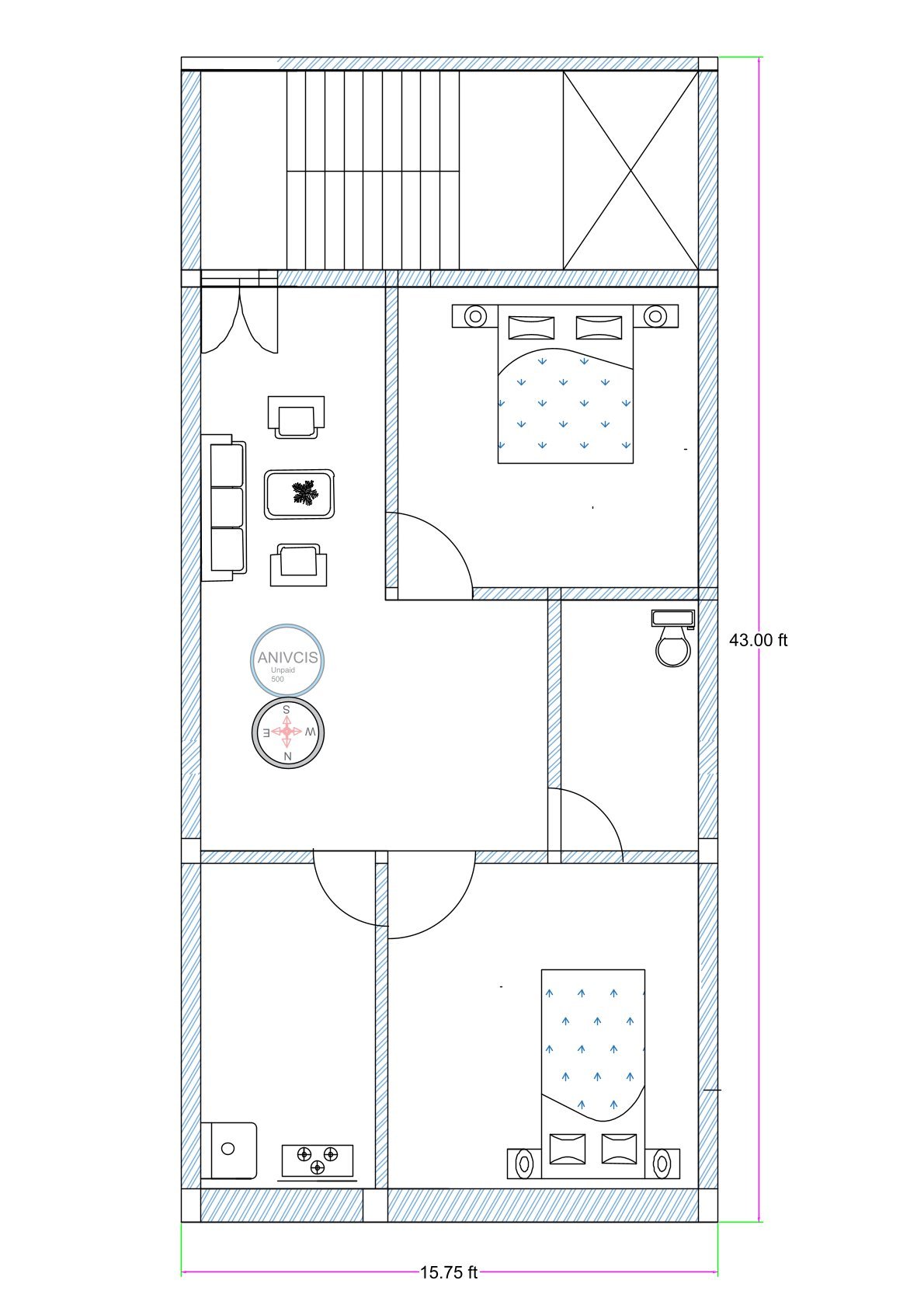
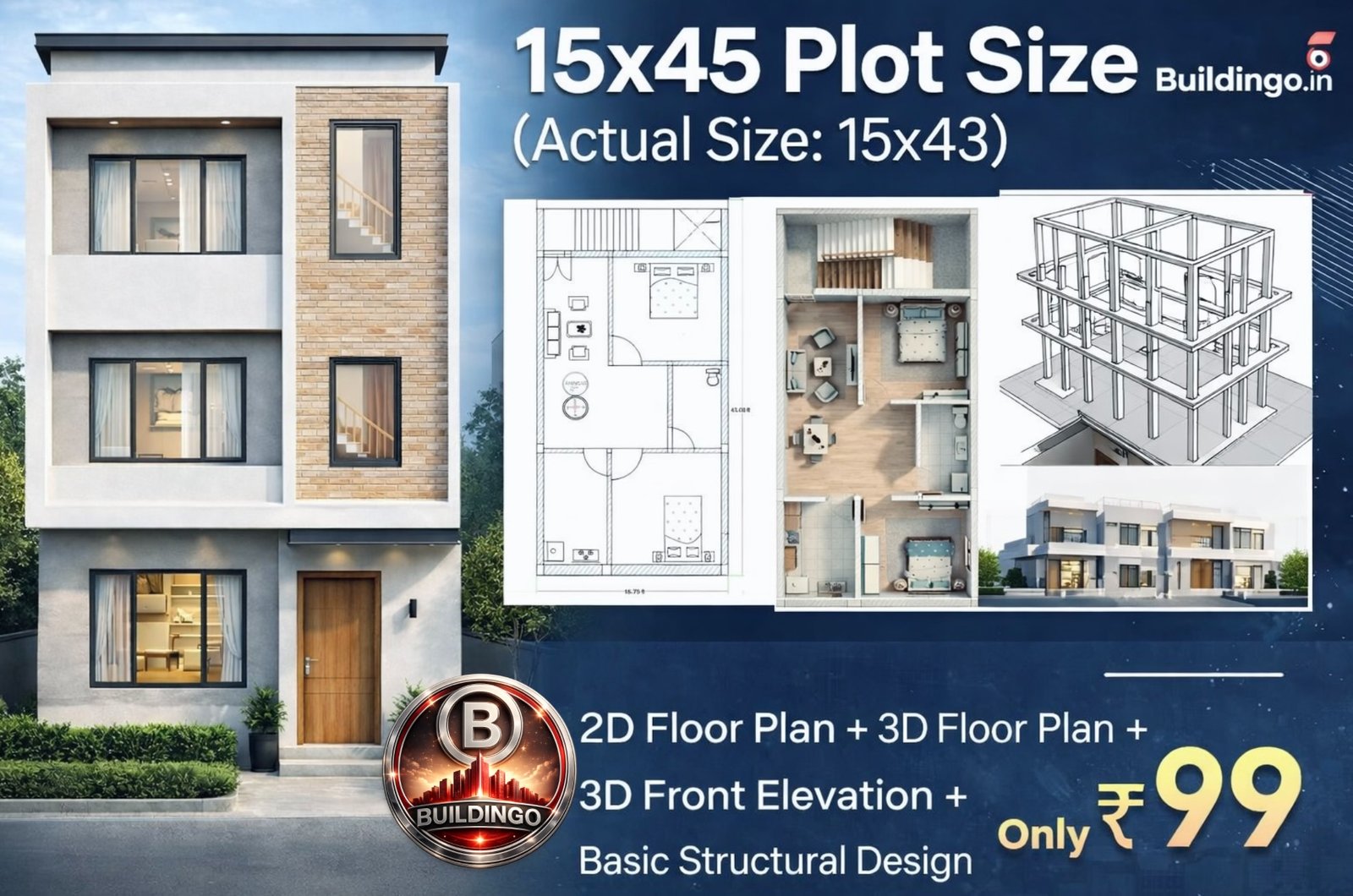
In this fourth narrow-plot series, we are discussing a highly practical and technically balanced house plan designed for an actual plot size of 15 feet wide and 43 feet deep, while for SEO and standard market reference we are considering it as a 15×45 plot size. This design is ideal for urban areas where depth is slightly more and width is restricted to 15 feet, which is very common in Indian cities and developing residential layouts.
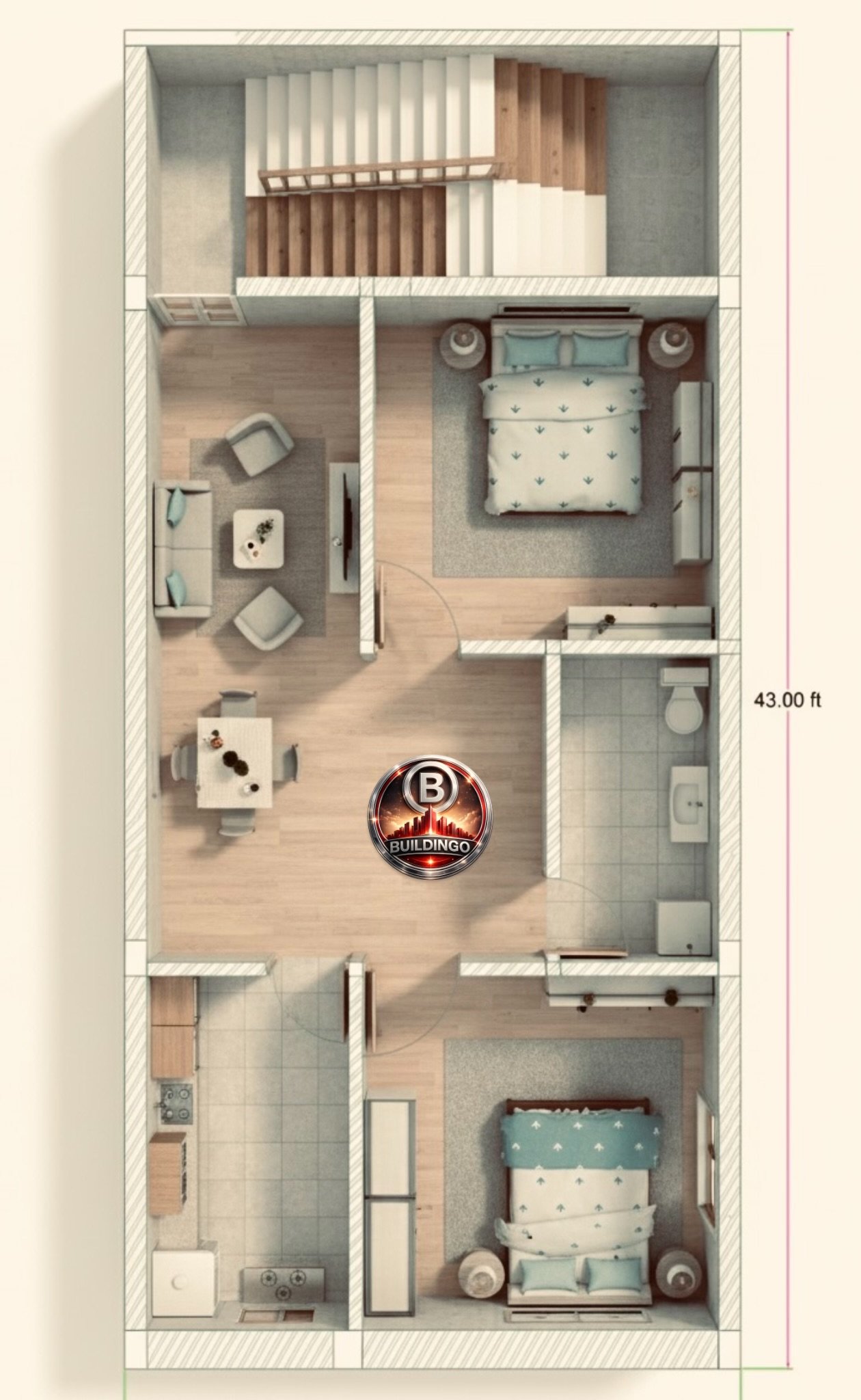
This project includes a 2D floor plan, 3D floor plan, 3D front elevation, and a basic structural design concept for G+2 construction, making it suitable for residential use as well as rental purposes.
Architectural Planning Concept – Space Utilization on 15 Feet Width
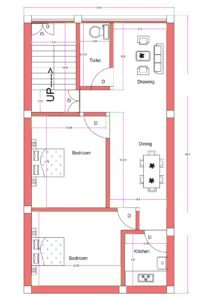
Designing within a 15-foot width requires intelligent zoning and circulation planning. In this layout, the staircase is placed in the front portion, measuring approximately 6’ x 14’, which creates a strong vertical circulation core. This allows independent access to upper floors if required, making the design suitable for a duplex or rental configuration.
After the staircase zone, we enter into the drawing room (approx. 6’ x 10’). Despite compact dimensions, the space is proportioned to accommodate a small sofa set and center table comfortably. Proper window placement ensures cross-ventilation and natural light, which is crucial in narrow homes.
Next comes the dining area (approx. 10’ x 8’), which acts as a central connecting space. From here, movement is distributed towards the kitchen, bedrooms, and toilet. This centralization improves circulation and avoids dead spaces.
The kitchen (approx. 5’ x 12’) is designed in a linear layout, ideal for narrow homes. The elongated proportion allows efficient counter placement, sink positioning, and proper ventilation. The long wall arrangement ensures optimal workflow triangle (sink–cooktop–storage).
Bedroom Planning – Functional and Proportional
This layout provides two bedrooms:
One bedroom near the staircase area (approx. 10’ x 12’)
One rear bedroom (approx. 9.5’ x 12’)
Both bedrooms are proportioned to comfortably accommodate a double bed, wardrobe, and circulation space. The rear bedroom benefits from better privacy, making it suitable as a master bedroom.
The toilet (approx. 4’ x 8’) is compact yet efficient. It follows a standard Indian residential module and can easily accommodate WC, wash basin, and shower space.
The zoning ensures:
Public area (drawing/dining) in the front-middle
Service area (kitchen/toilet) in the mid-zone
Private zone (bedrooms) at rear and side
This is a very practical planning logic for narrow residential units.
Structural Design Concept (Basic G+2 Concept )
As mentioned in previous blocks, the structural concept remains standardized for safety and clarity of understanding. This design is conceptual and meant for basic awareness. For final construction, local soil testing and structural consultancy are recommended.
1. Foundation
Pile foundation up to 15 feet depth
Pile connected with RCC pile cap
Plinth beam of 10” x 10”
Designed for G+2 load
Pile foundation ensures:
Better load transfer
Reduced differential settlement
Stability across varied Indian soil conditions
2. Column Design
Column size: 10” x 10”
Suitable for spans around 10 feet
Reinforcement to be designed as per load condition (minimum 4 bars of 12mm or equivalent structural logic depending on load)
Columns are placed in a grid system aligned vertically across floors to ensure load continuity.
3. Beam Design
Plinth beam: 10” x 10”
Roof beam: 10” x 10”
Beam above partition walls: 10” x 10”
Reinforcement: 10mm–12mm bars (as per structural requirement)
This uniform beam sizing simplifies execution and ensures symmetrical load transfer.
4. Slab Design
Slab thickness: 4” to 5” (depending on span and local code)
Main steel: 10mm
Distribution steel: 10mm
Spacing: 6 inches center to center
Alternate bar cutting possible in mid-span as per design logic
This configuration is safe for G+2 residential load conditions under normal Indian residential parameters.
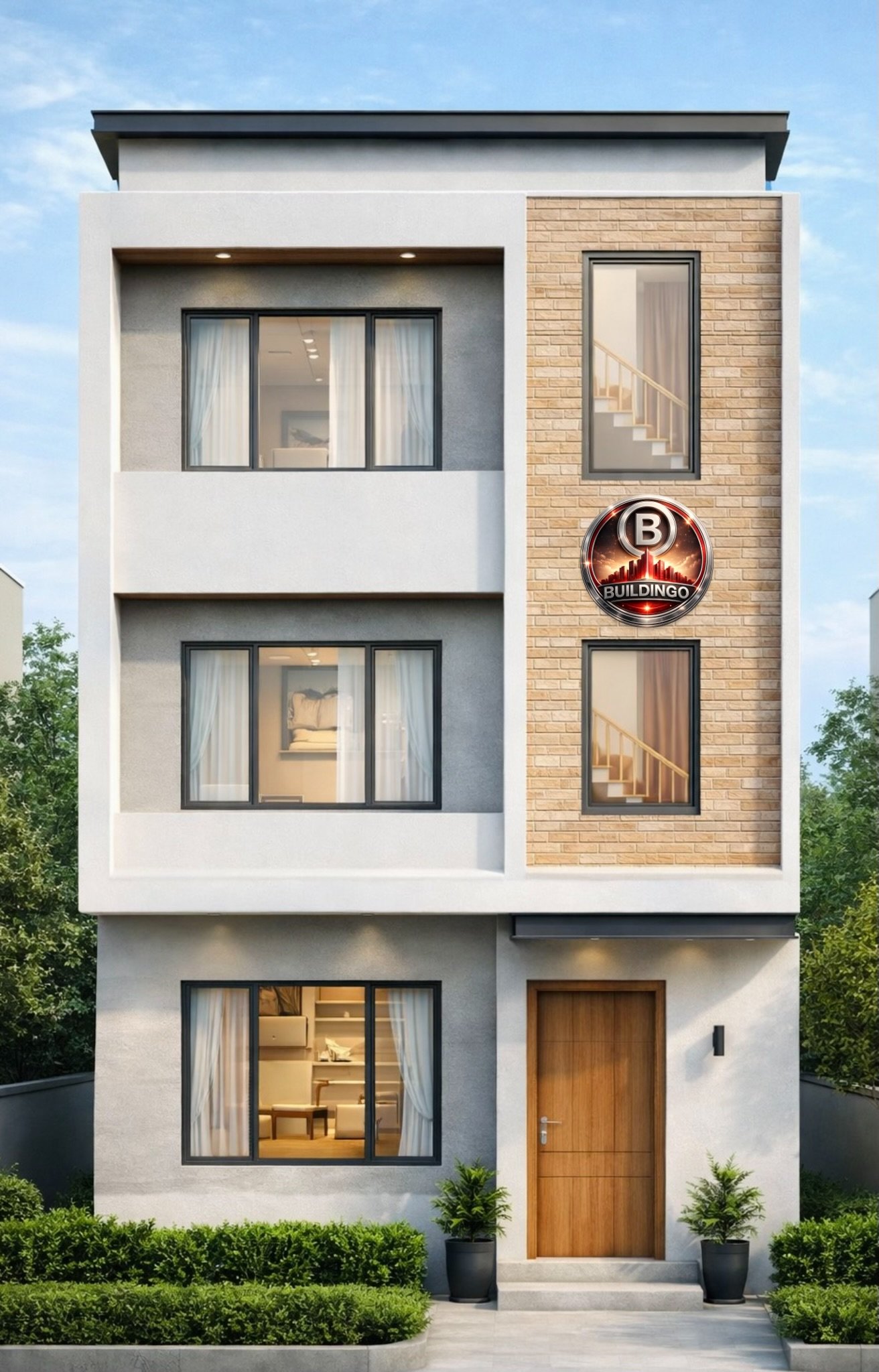
3D Elevation Concept – Modern Narrow Front
The 3D front elevation reflects a modern minimalist façade:
Balanced window placement
Vertical texture finish on one side
Clean horizontal slab projections
Compact entrance door design
Since the plot is only 15 feet wide, elevation symmetry and vertical proportion play a major role in visual appeal. The design ensures that even in narrow width, the building looks elegant and not congested.
Practical Advantages of This 15×45 (Actual 15×43) Plan
Suitable for urban narrow plots
G+2 ready structural logic
Ideal for rental floors
Easy to execute
Minimal wasted space
Efficient circulation
This design is perfect for middle-income families looking for a compact yet functional 2BHK solution.
Important Technical Disclaimer
The structural details provided here are a basic structural concept intended for educational and budget package understanding. Soil bearing capacity, seismic zone, and local building codes must be verified before execution. For final construction drawings, consultation with a licensed structural engineer is mandatory.
This 15×45 (Actual 15×43) narrow plot design continues our structured narrow-series concept. In the next block, we will move towards even deeper plots like 15×75 and 15×84 to explore multi-unit and rental-focused planning possibilities.
If you are working with a narrow 15-foot-wide plot, this model gives you a technically safe, architecturally balanced, and economically viable solution.
15×75 Feet Narrow Plot House Plan – Complete 2D + 3D Design with Structural Concept (G+2 Ready)
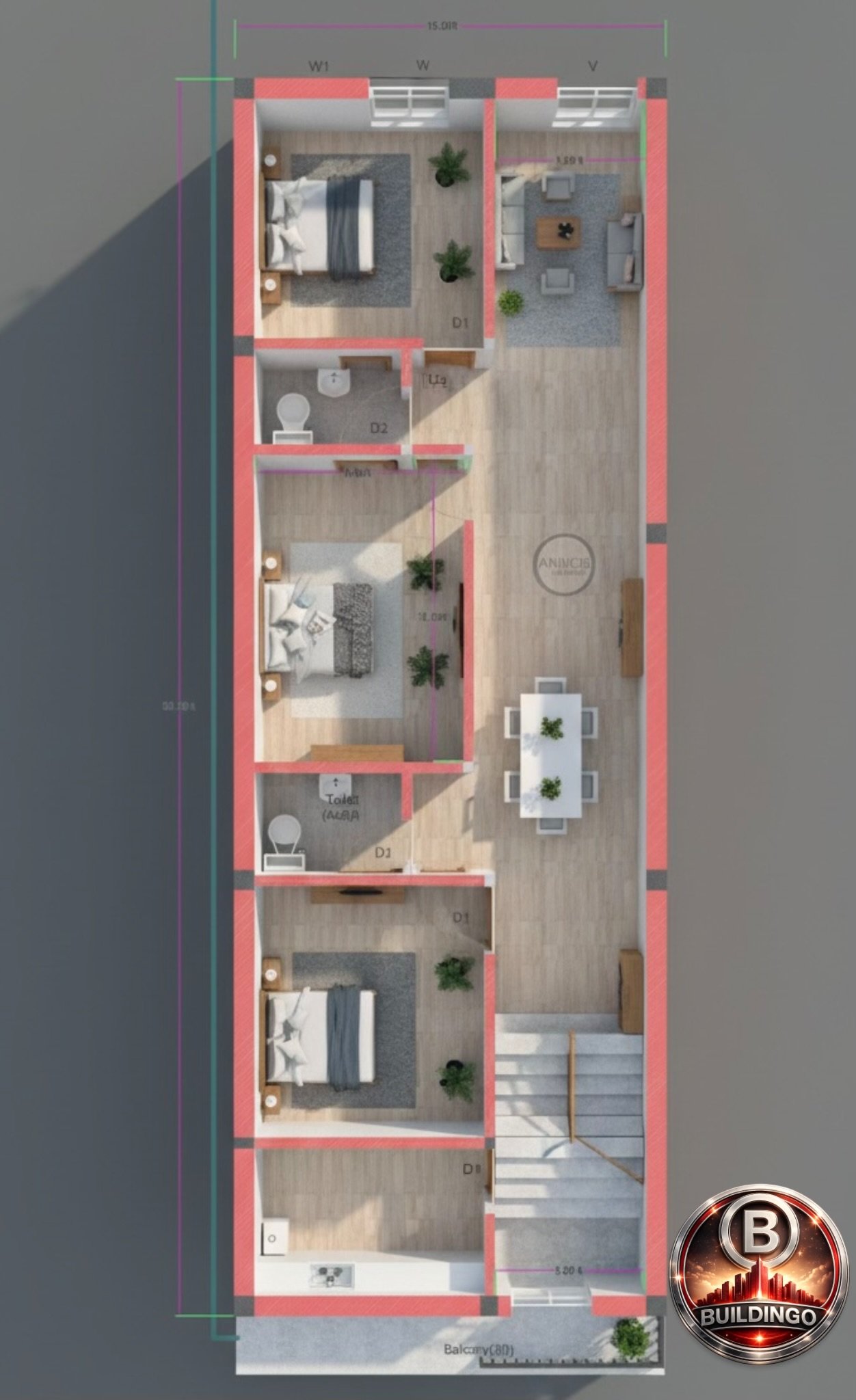
The 15×75 feet plot is one of the most practical and perfectly proportioned narrow plots available in urban India today. With a long depth of 75 feet and a compact 15 feet frontage, this size allows excellent internal planning, proper ventilation strategy, and a comfortable multi-bedroom layout without compromising structural safety. In this design, we have developed a complete architectural and basic structural concept including 2D floor plan, 3D floor plan, 3D front elevation, and G+2 structural layout.
This plot is ideal for families who want a spacious feel within a narrow frontage while keeping construction economical and structurally efficient.
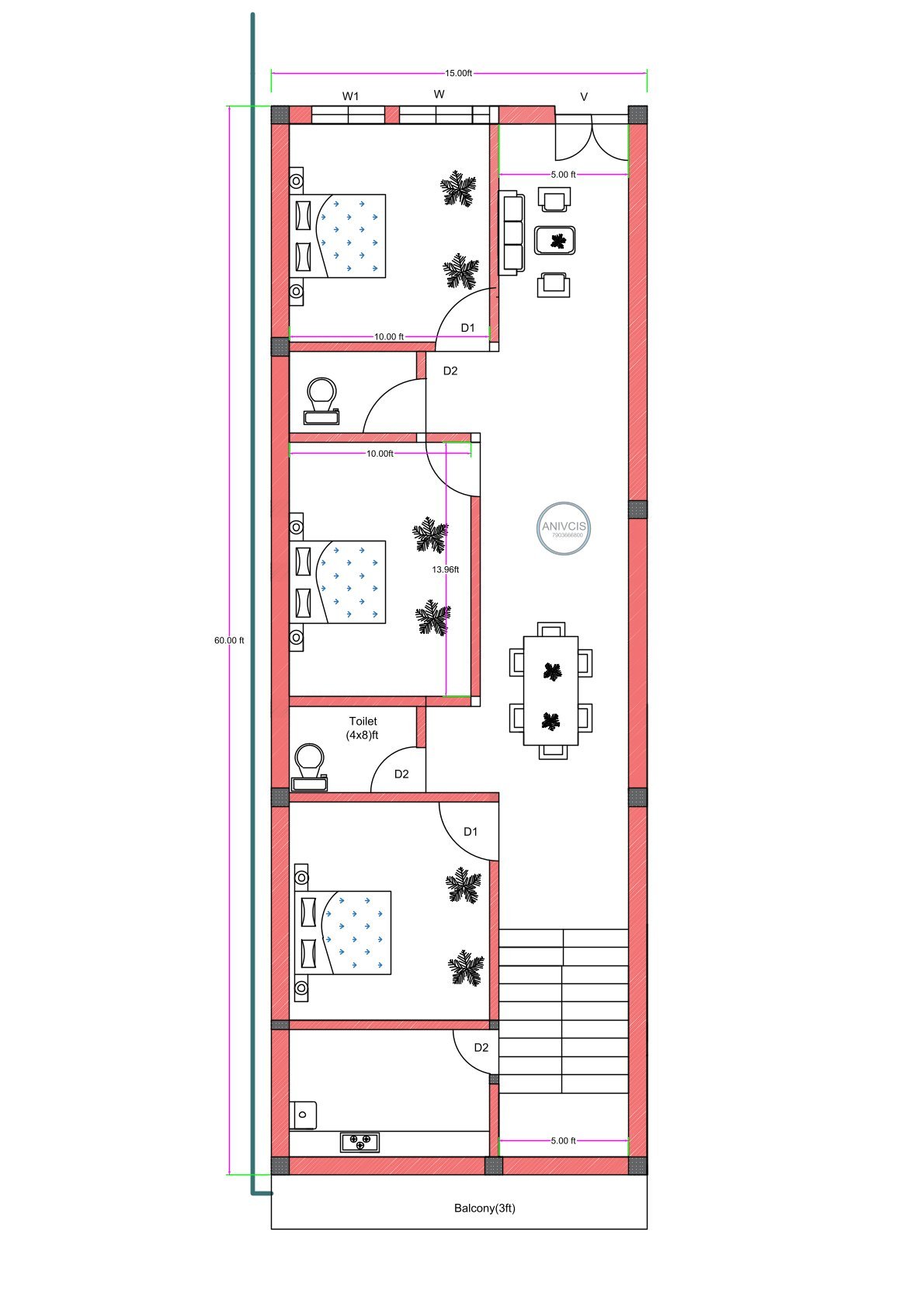
Architectural Planning Concept – 15×75 Layout
Because of the 75 feet depth, zoning becomes very important. Instead of compressing all rooms in the front, this design intelligently distributes spaces from public to private zones.
1. Front Zone – Entry and Living Area
The entrance opens into a well-proportioned drawing/living space that receives natural light from the front façade. Even with a 15 ft width, furniture placement is carefully aligned along one wall to maintain movement space. The staircase is placed strategically so that circulation remains smooth and future upper floors can function independently if required.
2. Central Zone – Dining and Transition
Moving inward, the dining space connects the front living area to bedrooms. This creates a natural privacy buffer. The long rectangular geometry of the plot works in your favor here, giving proper passage width and cross ventilation through aligned openings.
3. Kitchen Placement
The kitchen is positioned efficiently along one side wall, maintaining a practical working triangle between stove, sink, and refrigerator. In narrow plots, parallel kitchen layouts work best, and this design reflects that concept.
4. Bedroom Planning
With 75 feet depth, we can comfortably provide multiple bedrooms without congestion. The bedrooms are proportioned in a way that wardrobes fit without blocking circulation. Toilets are aligned vertically to ensure plumbing efficiency for G+2 construction.
5. Rear Utility or Open Space
The rear portion of the plot allows light and ventilation. In long plots, this back opening is extremely important to prevent a tunnel-like effect.
Structural Concept – Designed for G+2 (All India Basic Safety Model)
For this 15×75 plot, the same fundamental structural philosophy is followed as in previous designs, ensuring uniform strength and simplicity in execution.
Foundation
15 feet deep isolated footings (pile-type concept for weak soil zones).
Designed considering average SBC conditions across India.
All columns tied together with plinth beam to ensure lateral stability.
Columns
Standardized column size: 10” x 10”.
Suitable for G+2 residential structure when soil conditions are normal.
Column spacing maintained within safe span limits.
Beams
Plinth beam: 10” x 10”.
Roof beams: 10” x 10”.
Beams provided above partition walls to prevent crack development.
Reinforcement combination: 10 mm to 12 mm bars as per standard residential practice.
Slab Design
Slab thickness: 4” to 5” (depending on local conditions and span).
Main reinforcement: 10 mm bars.
Distribution reinforcement: 10 mm bars.
Spacing: 6 inches center-to-center.
Alternate bar cutting method adopted for economy while maintaining safety.
This structural layout ensures that even in a long 75 feet structure, load transfer remains uniform and torsion is minimized. However, for high seismic zones or special soil conditions, a local structural engineer must validate the design.
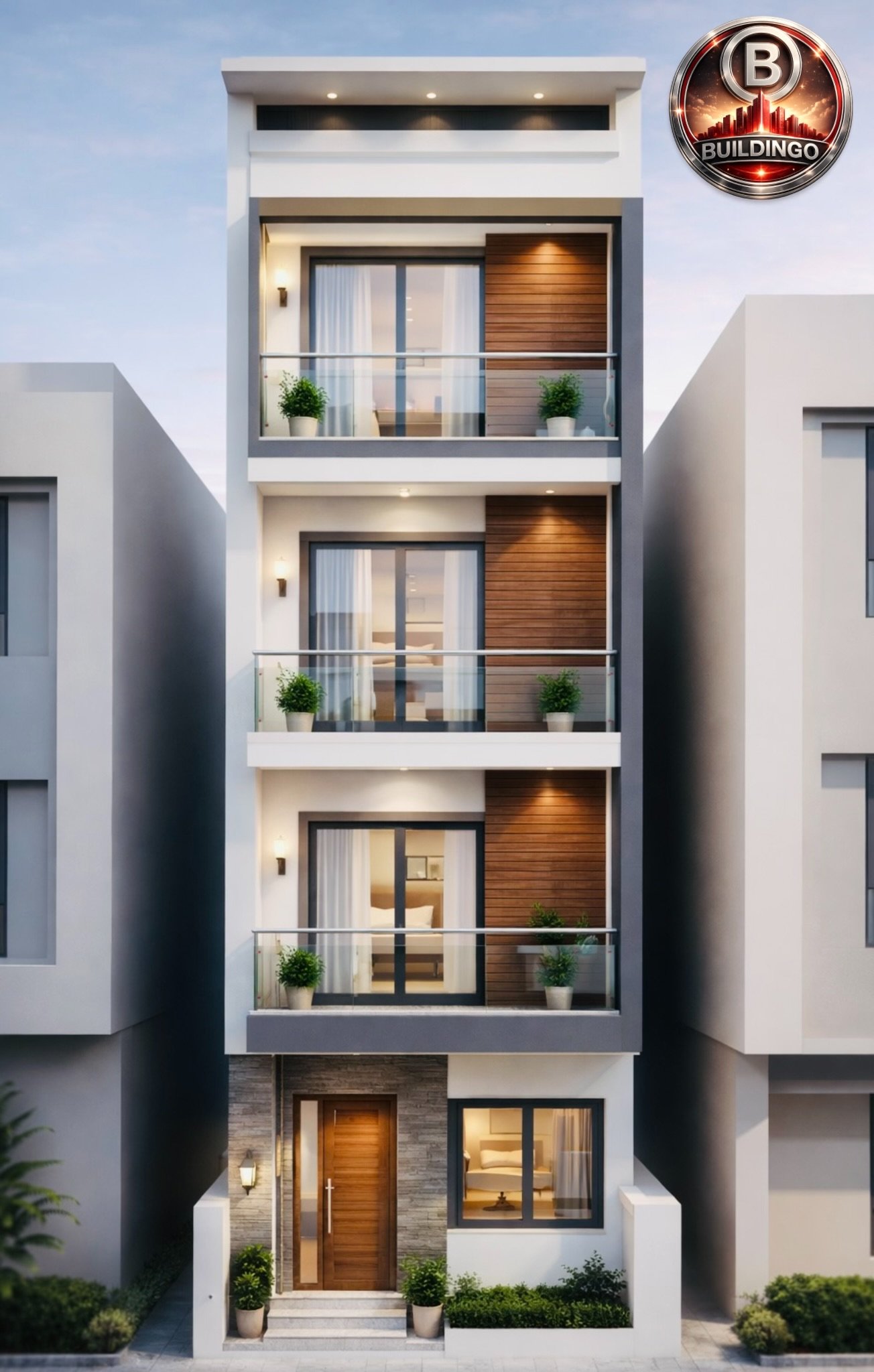
Elevation Design – Modern and Vertical Appeal
Because the frontage is only 15 feet, elevation design becomes crucial. The 3D front elevation uses:
Vertical panel elements to enhance height perception.
Balanced balcony projections.
Glass railing to reduce visual heaviness.
Neutral color palette with wooden texture highlights.
The elevation is designed in a way that it looks premium yet remains construction-friendly.
Civil Engineering Advantages of 15×75 Plot
Better Room Proportions – Unlike 15×30 or 15×45 plots, here bedrooms do not feel compressed.
Improved Ventilation Strategy – Long depth allows front and rear openings.
Future Expansion Friendly – Staircase positioning supports rental or independent floors.
Efficient Load Distribution – Column grid can be maintained in linear alignment.
Plumbing Efficiency – Toilets stacked vertically reduce cost and leakage risk.
Cost and Construction Practicality
The 15×75 layout is economical in terms of structural repetition. Since column and beam sizes remain consistent, labor execution becomes simple. Standardization reduces construction errors.
This plan is provided with:
2D Floor Plan
3D Floor Plan
3D Front Elevation
Basic Structural Design (G+2 Ready Concept)
The combo package allows homeowners to clearly understand architecture plus structure before approaching a contractor.
Important Technical Disclaimer
The structural concept provided is a basic safe residential model suitable for most Indian soil categories under normal conditions. However:
Final design must be verified as per local soil test report.
Seismic zone compliance must be checked.
Local building bylaws should be followed.
For complete structural detailing (footing depth calculation, load analysis, seismic detailing, bar bending schedule), consultation with a licensed structural engineer is recommended.
Final Thoughts
The 15×75 plot is one of the most balanced narrow plot sizes for a comfortable family home. It allows proper zoning, ventilation, aesthetic elevation, and strong structural alignment. Compared to smaller depth plots, it gives freedom in planning without compromising the 15 ft narrow frontage challenge.
This design is ideal for families looking for a spacious yet efficient G+2-ready home that combines architectural intelligence with civil engineering practicality.
In the next blogs, we will continue exploring other narrow plot dimensions with the same technical depth and clarity.
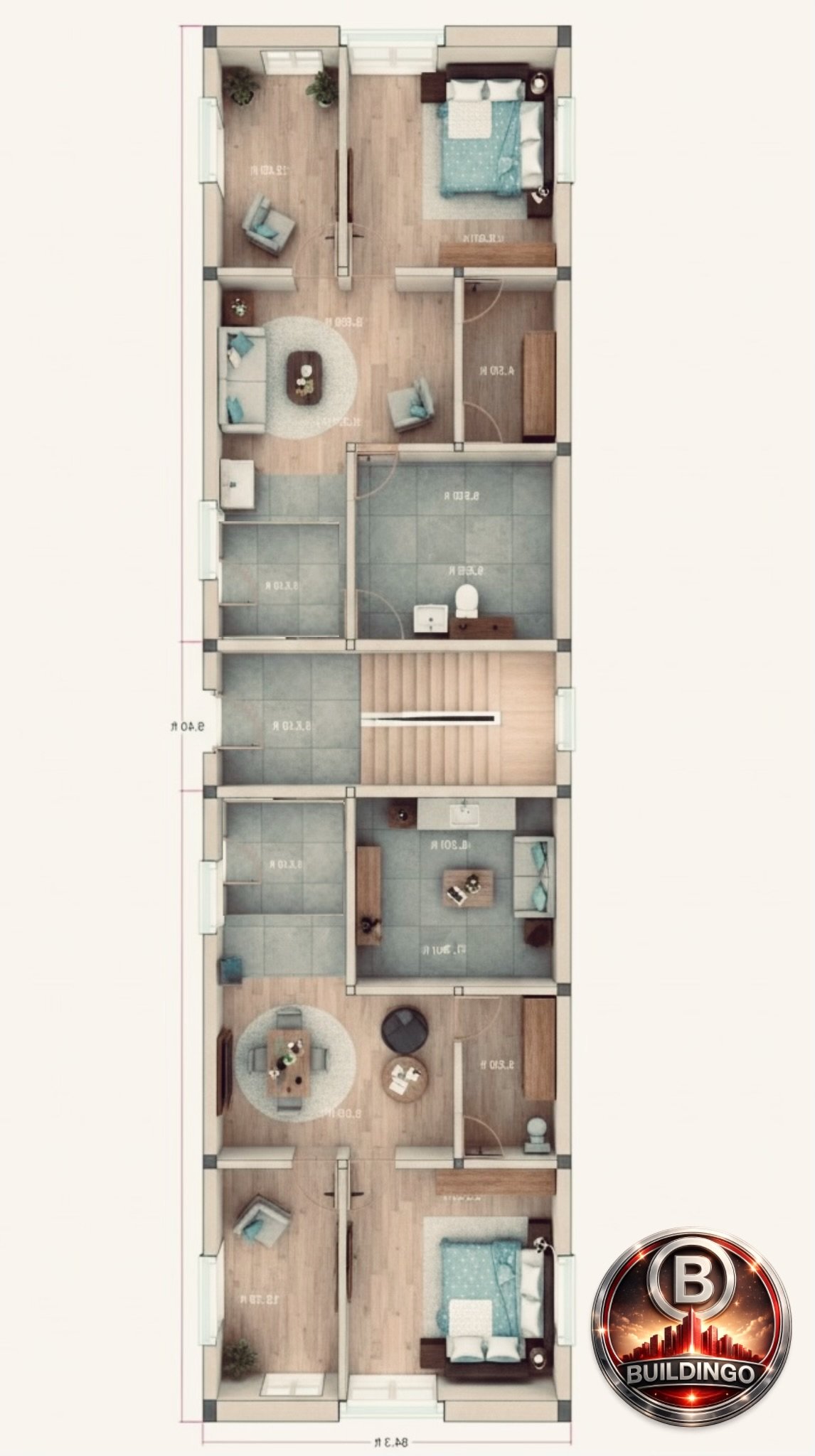
15×85 Narrow Plot House Design (Actual Size 15×84) – Two 2BHK Flats | Complete Architectural + Structural Concept for G+2
This is the final and most comprehensive design in our 15-feet wide narrow plot series. The actual plot size is 15 feet × 84 feet, but for SEO and standard search format, we are presenting it as 15×85 plot size. This design is specially planned for maximum space utilization, structural safety, rental potential, and long-term durability under Indian site conditions.
In this configuration, the building is planned as G+2 structure, accommodating two 2BHK flats, making it ideal for rental income, joint families, or future expansion.
Architectural Planning Concept – 15 Feet Wide Deep Plot
Designing on a 15-foot width is always a challenge. The main objective is:
Proper ventilation
Natural lighting
Functional circulation
Structural symmetry
No wasted corridor space
In this plan, the layout is divided intelligently into front and rear zones, connected through a centrally aligned staircase block. The staircase is placed in such a way that it does not disturb the privacy of either flat.
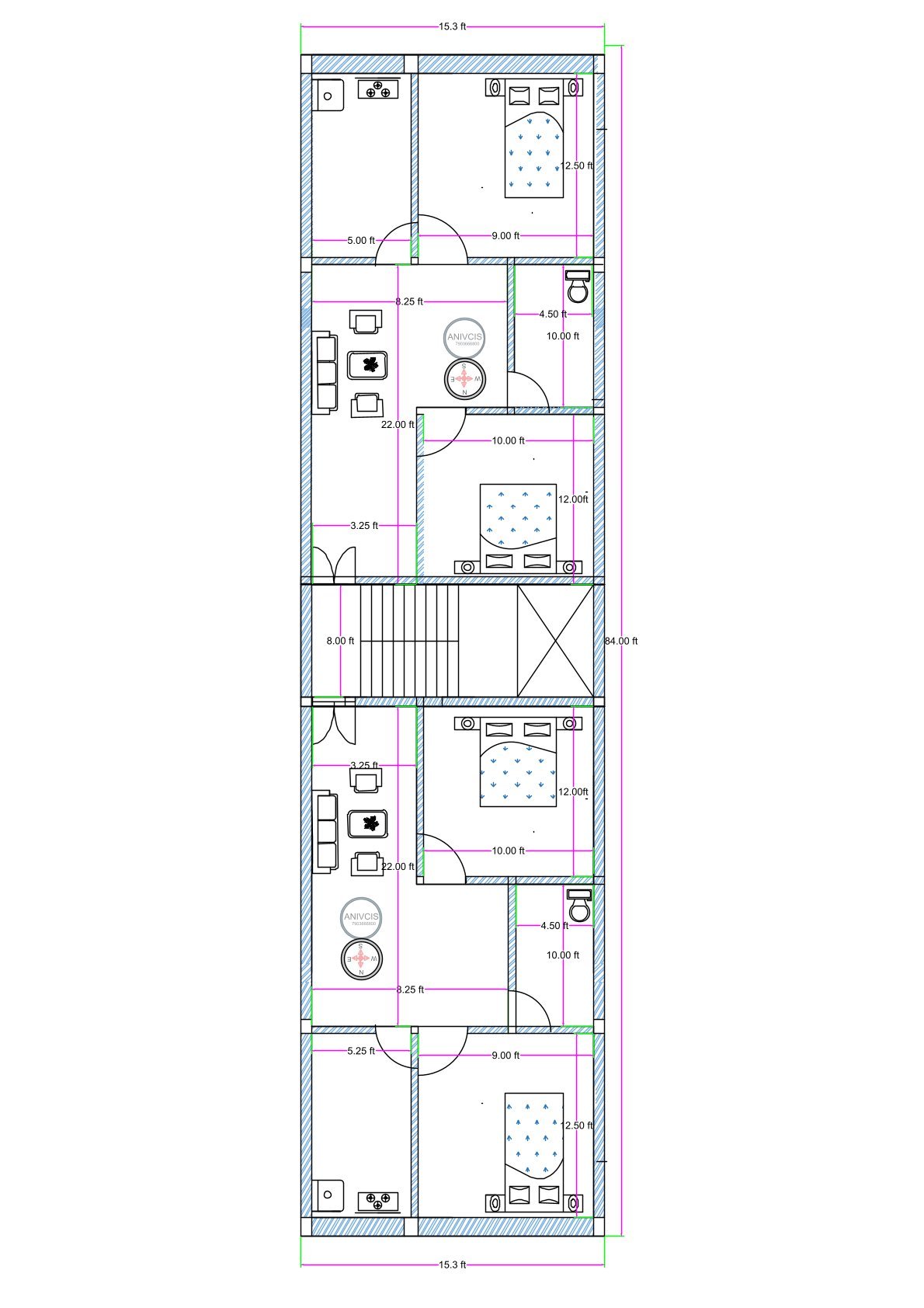
Ground Floor Planning (Typical Unit Concept)
Each 2BHK flat includes:
Drawing / Living area
Dining space
Kitchen
Two Bedrooms
Common Toilet
Circulation passage
Staircase block
Because the plot is deep (84 feet), the plan allows for:
Better air movement
Segregation of private and semi-private zones
Proper Vastu alignment possibilities
The living and dining areas are arranged longitudinally to reduce congestion. Bedrooms are placed at both ends to maintain privacy and noise separation.
The kitchen is positioned in a practical rectangular module, allowing straight platform layout and efficient plumbing routing.
Space Planning Strategy for Narrow Deep Plots
In a 15-foot width, we avoid unnecessary lobbies. Instead:
Rooms open directly into functional areas
Circulation is minimized
Walls are aligned vertically for structural continuity
Wet areas are stacked for plumbing efficiency
The staircase is centrally located and vertically aligned through all floors. This ensures:
Proper load transfer
Structural symmetry
Ease of future expansion
The 3D floor plan clearly demonstrates furniture layout feasibility, proving that even within 15 feet width, comfortable movement is possible without feeling congested.
3D Front Elevation Concept – Modern Vertical Expression
The elevation reflects a modern minimalistic façade, emphasizing vertical lines to complement the narrow width.
Key features:
Balanced window placement
Balcony projections for depth
Glass railing for openness
Wooden texture cladding panels
Warm lighting under slab projections
Strong rectangular framing
Because this is a narrow plot between adjacent buildings, elevation depth is achieved through:
Recessed balcony
Texture contrast
Vertical stone panel
Controlled projection design
This type of elevation works well in urban Indian cities where side setbacks are minimal.

Structural Design Concept – Standardized Safe Basic Design (G+2)
As discussed in earlier plots, the structural concept remains uniform for reliability across India (subject to soil testing and seismic zone verification).
Foundation
Pile foundation 15 feet below ground level
Designed for G+2 load transfer
Suitable for average SBC soil conditions
All columns connected with plinth beam
Plinth Beam
Size: 10″ x 10″
Continuous tie beam
Prevents differential settlement
Provides rigidity
Column Design
Size: 10″ x 10″
Uniform vertical alignment
Designed for 10 ft span
Continuous through all floors
Beam Design
10″ x 10″ beams
Running above partition walls
Half 10mm to 12mm reinforcement bars
Proper anchorage length maintained
Slab Design
Thickness: 4″ to 5″
Main reinforcement: 10mm bars
Distribution steel: 10mm bars
Spacing: 6″ center to center
Alternate bars curtailed as per design logic
This is a basic structural concept for ₹99 combo package. It is safe for standard conditions, but for final execution, site-specific structural consultation is always recommended.
Civil Engineering Perspective
From an engineering standpoint, this design ensures:
Load continuity from slab to foundation
Minimal torsional irregularity
Symmetrical column grid
Reduced beam span
Uniform vertical load path
Controlled deflection
Because the plot is deep (84 feet), expansion joints are not required in this scale, but proper curing and joint detailing must be maintained.
Wet areas are stacked vertically, reducing plumbing complexity and minimizing slab cutting.
Rental & Investment Advantage
This 15×85 (actual 15×84) plot is ideal for:
Two independent 2BHK flats
Owner on one floor, rental on another
Full rental building
Future vertical extension
With G+2 structure, you can:
Live on ground floor
Rent first floor
Keep second floor for future
Or develop full rental model.
Why This is the Most Accurate 15-Foot Plot Design
Compared to smaller depth plots (15×20, 15×27, 15×36, 15×45, 15×75), this 15×85 plot offers:
Maximum flexibility
Two complete functional units
Balanced light and ventilation
Clear zoning
Better rental potential
Proper staircase integration
Strong structural continuity
This is the most optimized deep narrow plot configuration in this series.
What You Get in the Combo Package
2D Floor Plan
3D Floor Plan
3D Front Elevation
Basic Structural Concept (G+2)
Clear dimension references
Planning ready format
All individual drawings will be available as free viewing images in the blog (24 total images across series).
The complete combo package will be chargeable and linked separately.

Final Conclusion – What We Learned from All 15-Foot Plot Designs
From 15×20 to 15×85 (actual sizes varying), one key lesson is clear:
Width is limitation, but length is opportunity.
With correct architectural planning and disciplined structural alignment:
Even 15 feet width can support G+2 safely
Functional 2BHK units are possible
Rental model works efficiently
Ventilation can be maintained
Structural safety can be standardized
Across all six plot sizes, the core engineering principle remained constant:
Uniform column size
Controlled span
Standard beam dimensions
Practical slab reinforcement
Pile foundation for safety
This series proves that narrow plots are not a disadvantage.
They are simply engineering challenges waiting for intelligent design.
A 15-foot-wide plot is never a limitation — it is a design opportunity waiting to be engineered intelligently. From 15×20 to 15×85 (actual 15×84), this complete study proves that with proper architectural planning, scientific space utilization, and a strong RCC structural framework, even the narrowest plot can transform into a modern, aesthetic, and structurally safe G+2 or G+3 home.
Through these six configurations, we have learned that intelligent column placement, beam continuity, ventilation strategy, staircase positioning, and vertical development matter more than plot width. When civil engineering principles align with thoughtful architectural design, a narrow plot becomes a perfectly functional, beautiful, and investment-worthy property. This blog was written to show that great homes are not defined by width — they are defined by planning, structure, and vision.
इस ब्लॉग का हिंदी संस्करण वास्तु शास्त्र के विस्तृत विश्लेषण के साथ पढ़ने के लिए यहाँ क्लिक करें।
Follow Us On Youtube
Follow Us On Facebook
Buildingo Blog