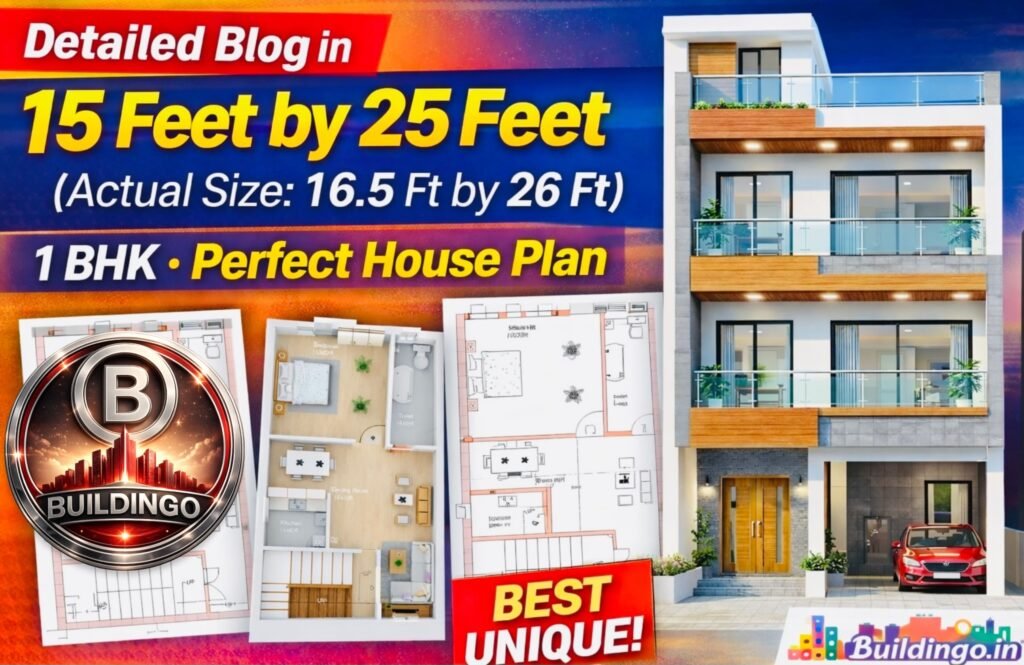
Buildingo :- Introduction: The Rise of Compact Urban House Construction in India
In today’s rapidly growing urban landscape, especially across Indian cities and tier-2 towns, compact residential plots such as 15×25 feet (actual structural planning size approximately 16.5 ft x 24–26 ft) are becoming increasingly common.
With rising land prices, shrinking plot sizes, and increasing construction costs, homeowners are now searching for:
- Smart small plot house plans
- G+2 house designs for narrow width plots
- Budget-friendly structural solutions
- Modern elevation designs for compact homes
- Rental-friendly vertical house plans
This blog presents a complete technical and structural explanation of a well-planned 15×25 house design that includes:
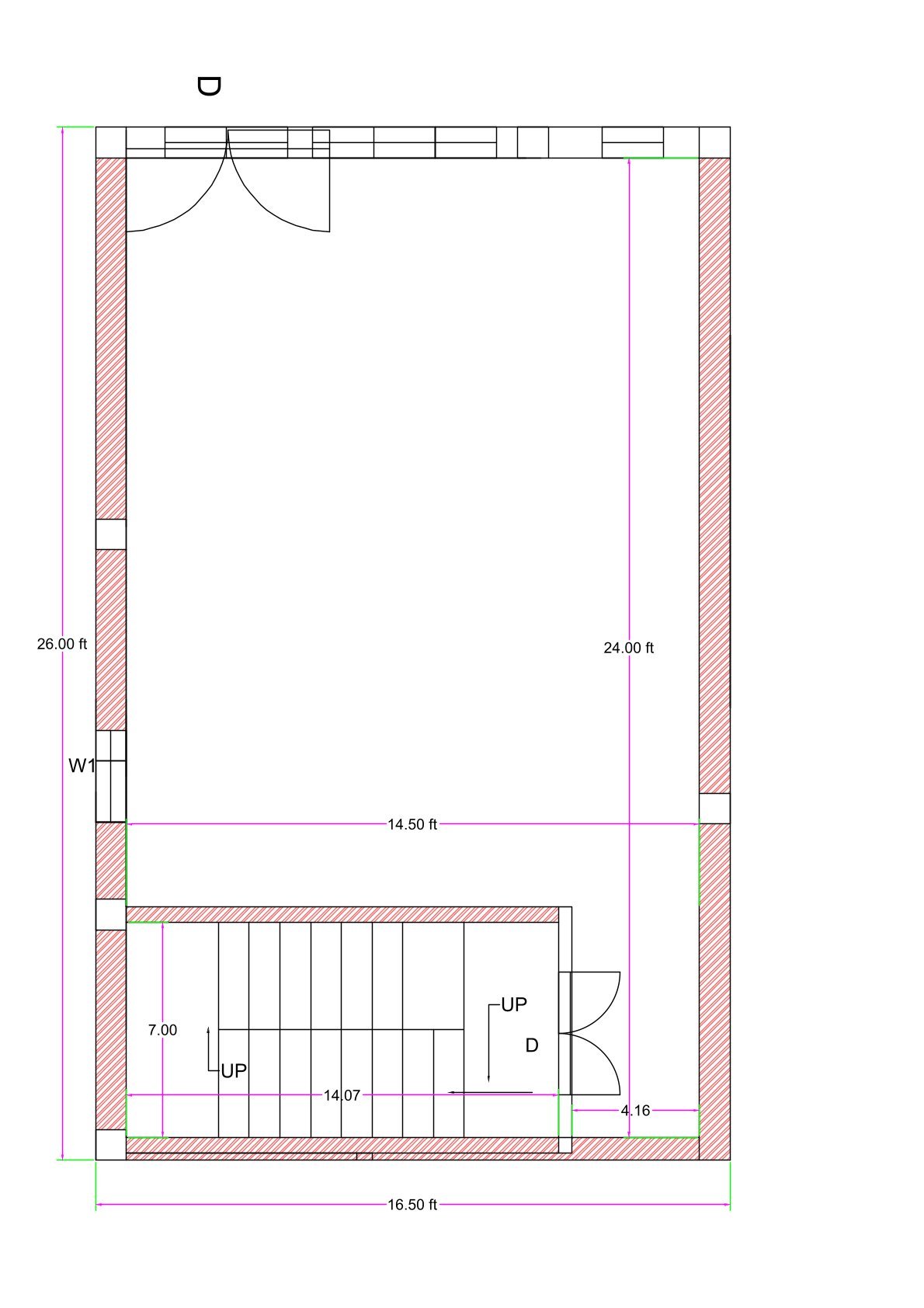
- Ground floor parking with staircase
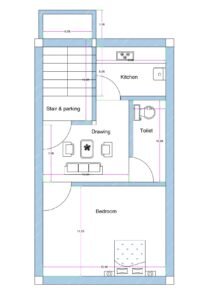
- First floor 1BHK plan
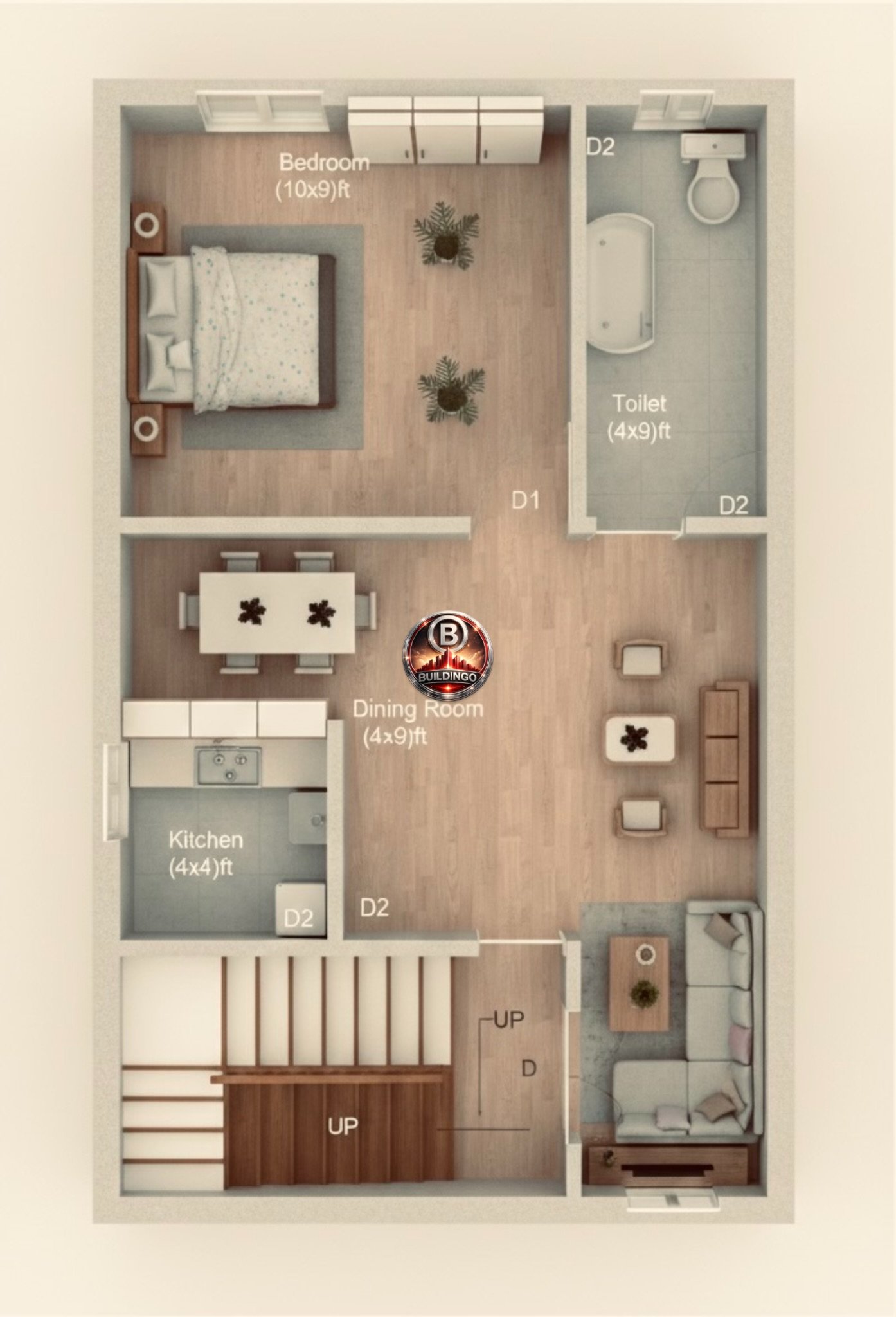
- Realistic 3D floor plan
- Modern G+2 front elevation
- Basic structural design concept
- ₹99 downloadable combo package
This is not just an architectural plan — this is a civil engineering-driven structural concept optimized for safety, cost-efficiency, and long-term durability.
1. Is a 15×25 feet plot suitable for building a G+2 house?
Yes, a 15×25 feet plot (actual structural size approximately 16.5×26 feet) is fully suitable for constructing a G+2 residential house when properly designed using an RCC framed structure. With correctly aligned columns, beams, slab thickness, and a strong foundation system such as a 15-foot deep pile foundation, the building can safely support two additional floors. The key factor is proper structural grid planning and load transfer alignment from slab to beam to column to foundation.
Plot Dimensions & Planning Logic
Marketed Size: 15×25 feet
Actual Structural Planning Size: 16.5 feet width x 24–26 feet depth
Building Type: G+2 Residential Structure
Usage: Self-use + Rental Potential
Compact plots require precision structural planning. Unlike large plots where flexibility is high, small plots demand:
- Proper column alignment
- Load path clarity
- Minimal beam complexity
- Wall alignment above beams
- Balanced reinforcement strategy
This design is column-based structural planning, not load-bearing wall planning — which makes it future expansion ready.
Structural Design Philosophy for Narrow Plots
Designing a narrow 15 ft wide house is not just about fitting rooms.
It requires:
- Balanced column grid
- Reduced slab span
- Controlled beam depth
- Minimal torsion
- Lateral stability
- Deep foundation reliability
The entire building follows a clear vertical load transfer mechanism:
Slab → Beam → Column → Pile → Soil
This prevents uneven settlement and structural stress concentration.
2. What type of foundation is best for a 15×25 small plot house?
For compact urban plots like 15×25 feet, a 15 feet deep pile foundation is highly recommended, especially in areas where soil bearing capacity is uncertain. Pile foundations transfer load to deeper, stronger soil layers and reduce the risk of differential settlement. In narrow plots where excavation space is limited, pile foundations provide better long-term stability compared to isolated shallow footings.
Column Layout – The Backbone of This 15×25 House Plan
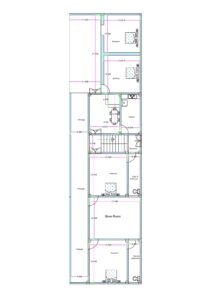
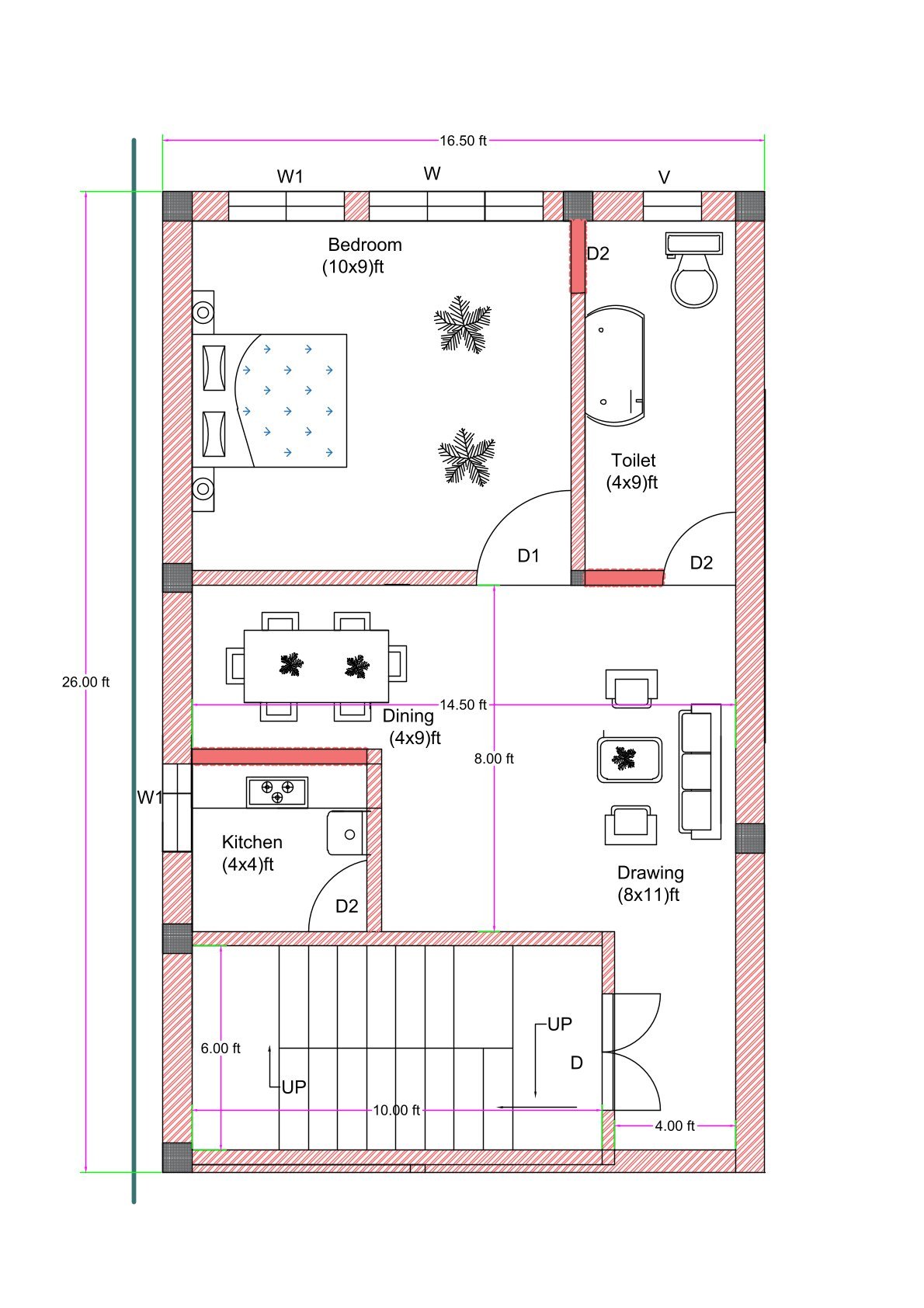
In the 2D plan, black square marks represent structural RCC columns.
Total Columns: Approximately 8
Why 8 columns?
- Fewer columns = overloaded beams
- Too many columns = space wastage
- 8 columns provide balanced structural grid
Column Size: 10 inches x 10 inches (250mm x 250mm approx.)
Uniform column size ensures:
- Structural symmetry
- Easier construction
- Simplified shuttering
- Reduced cost variation
- Proper vertical alignment for G+2
In small houses, uniformity improves structural performance.
Foundation System – 15 Feet Deep Pile Foundation
For compact urban houses, foundation is critical.
Proposed Foundation:
Pile foundation of 15 feet depth below ground level.
Why pile foundation for small plot house?
- Soil bearing capacity may vary in urban areas
- Adjacent structures restrict spread footing
- Narrow excavation limits
- Settlement control requirement
- Future vertical expansion load
Pile foundation ensures:
- Deep load transfer
- Reduced differential settlement
- Long-term durability
- Stability for G+2 construction
Plinth Beam – Structural Binding Element
At ground level, all columns are connected with a:
10″ x 10″ Plinth Beam
Purpose:
- Tie entire structure
- Prevent independent column movement
- Improve earthquake resistance
- Distribute wall load
- Reduce crack formation
In narrow plots, plinth beam plays a crucial role because lateral movement space is minimal.
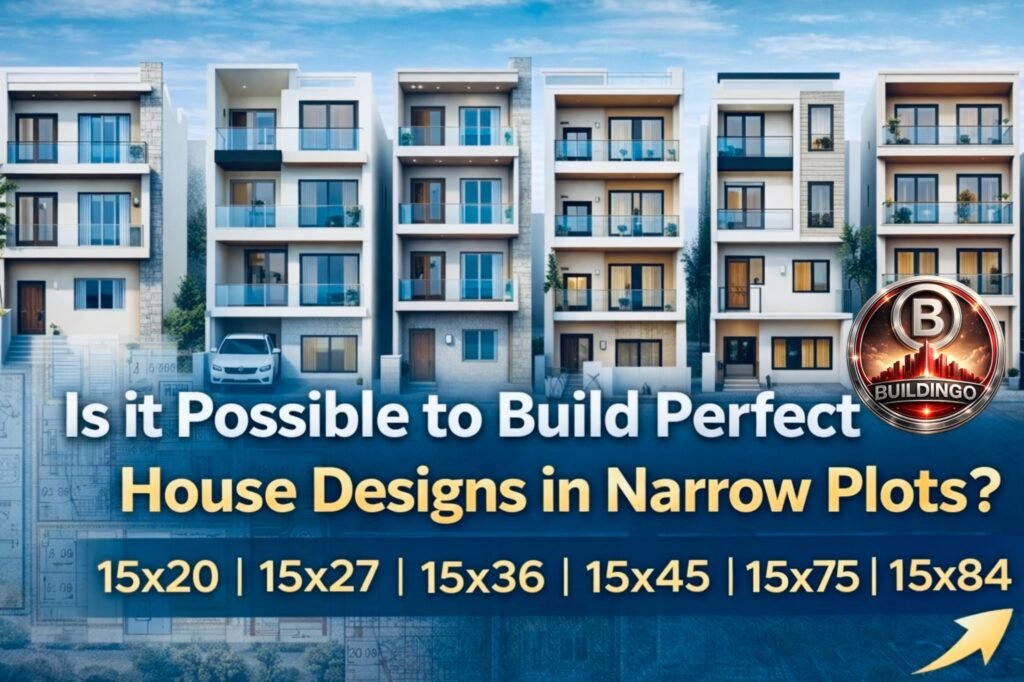
How to Build Perfect House Designs on 15 Feet Wide Narrow Plots (15×20 to 15×85) | G+2 Modern Elevation, Floor Plans & Basic Structural Design Guide
Beam Design Strategy in Compact G+2 House
Beams are provided wherever partition walls exist.
This is a critical structural principle:
Walls must sit directly above beams.
Beam Size:
10 inches x 10 inches
Why same size as column?
- Uniform load behavior
- Easier construction
- Economical
- Reduced design confusion
- Balanced moment resistance
In small span residential buildings, overdesigning beams increases cost unnecessarily.
Slab Thickness & Design Concept
Slab Thickness:
4 inches to 5 inches (100–125 mm)
Because the span between beams is short, this thickness is structurally sufficient for:
- Residential loading
- Furniture load
- Human load
- G+2 configuration
Thicker slab increases dead load and cost without benefit in such compact grids.
3. How many columns are required for a 15×25 G+2 house plan?
Typically, around 8 RCC columns are sufficient for a properly designed 15×25 G+2 residential building. In this structural concept, columns of 10 inches by 10 inches are used to maintain balance and uniformity. The number of columns ensures proper load distribution without overcrowding the limited floor space. Correct column placement is more important than just the quantity.
Reinforcement Detailing – RCC Strength Explained
Column Reinforcement
- 4 bars of 10mm to 12mm diameter
- Stirrups at 6 inches center to center
This ensures:
- Adequate axial load capacity
- Buckling resistance
- Shear confinement
- Basic seismic resistance
Beam Reinforcement
- 10mm main steel
- Stirrups at 6 inch c/c
Provides:
- Flexural strength
- Crack control
- Load distribution stability
Slab Reinforcement
- 10mm main steel
- 10mm distribution steel
- 6 inches center to center spacing
Advantages:
- Reduced deflection
- Crack resistance
- Long-term durability
- Stronger slab rigidity
For compact homes, slightly conservative slab reinforcement improves lifespan.
Wall Thickness Optimization
Exterior Wall:
10 inches
Benefits:
- Thermal insulation
- Sound insulation
- Structural rigidity
- Weather protection
Interior Wall:
5 inches
Benefits:
- Space saving
- Reduced dead load
- Cost efficiency
- Functional partition
This wall thickness balance improves structural and economic performance.
4. What slab thickness is recommended for this compact G+2 house?
For a residential structure of this size, a slab thickness of 4 to 5 inches (100–125 mm) is generally sufficient when supported by properly spaced RCC beams. Since the span between beams in compact plots is small, excessive slab thickness is not required. Proper reinforcement using 10 mm steel bars at 6 inches center to center ensures durability and crack control.
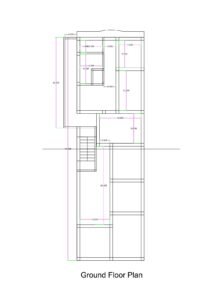
Ground Floor Planning – Parking + Staircase Structural Advantage
The ground floor includes:
- Parking space
- Staircase block
- Entry circulation
Structurally:
- Staircase block acts as rigid core
- Enhances lateral stability
- Reduces building sway
- Improves load distribution
In narrow G+2 houses, staircase positioning significantly improves stiffness.
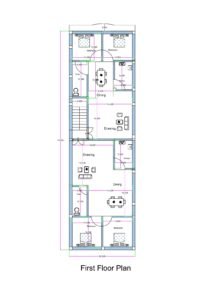
First Floor 1BHK Layout – Structural Alignment
Rooms are aligned with column grid to avoid:
- Floating beams
- Unsupported walls
- Load transfer irregularities
Room Sizes:
- Bedroom: 10×9 ft
- Drawing: 8×11 ft
- Dining: 4×9 ft
- Kitchen: 4×4 ft
- Toilet: 4×9 ft
All walls are positioned directly above beams for clean load path.
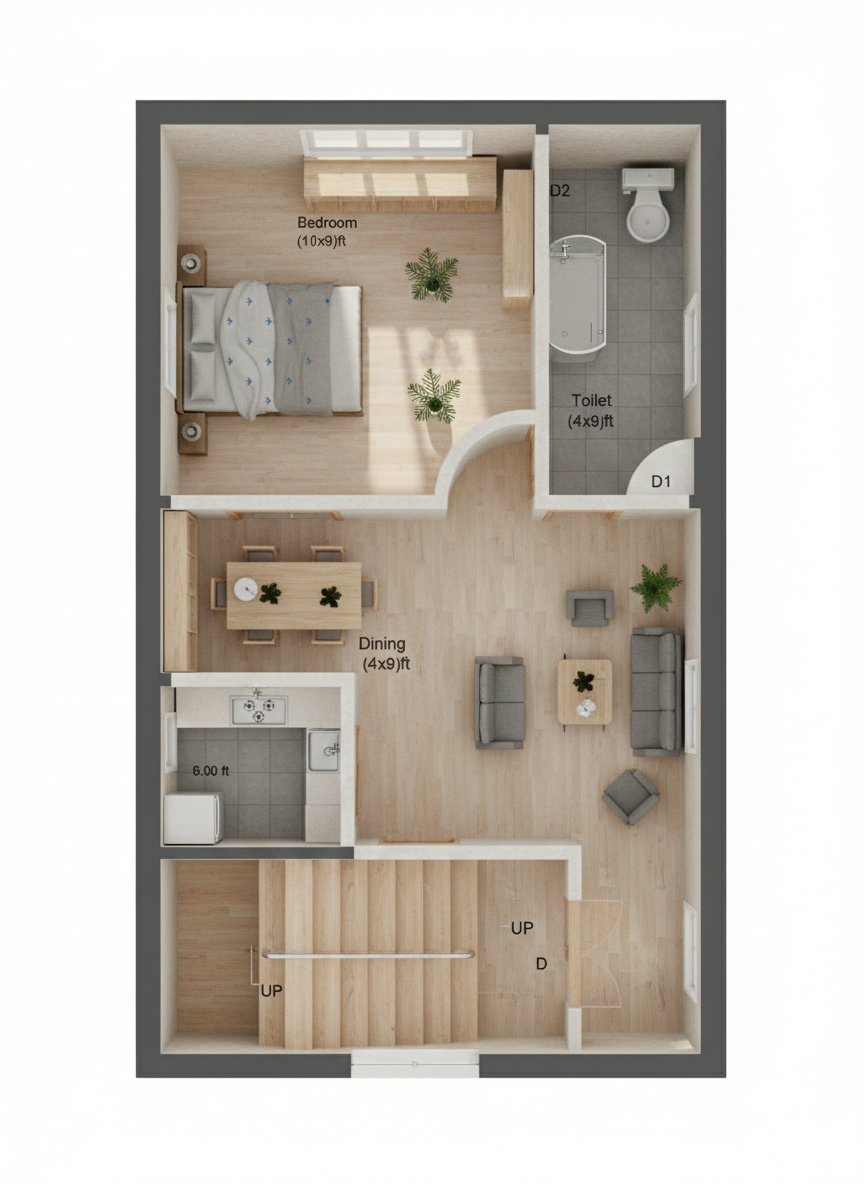
3D Floor Plan – Engineering Perspective
Many assume 3D plan is only for aesthetics.
In reality, it helps:
- Validate furniture clearance
- Confirm door opening radius
- Detect beam projection issues
- Identify ventilation gaps
- Improve functional flow
The provided 3D floor plan ensures the compact design does not feel congested.
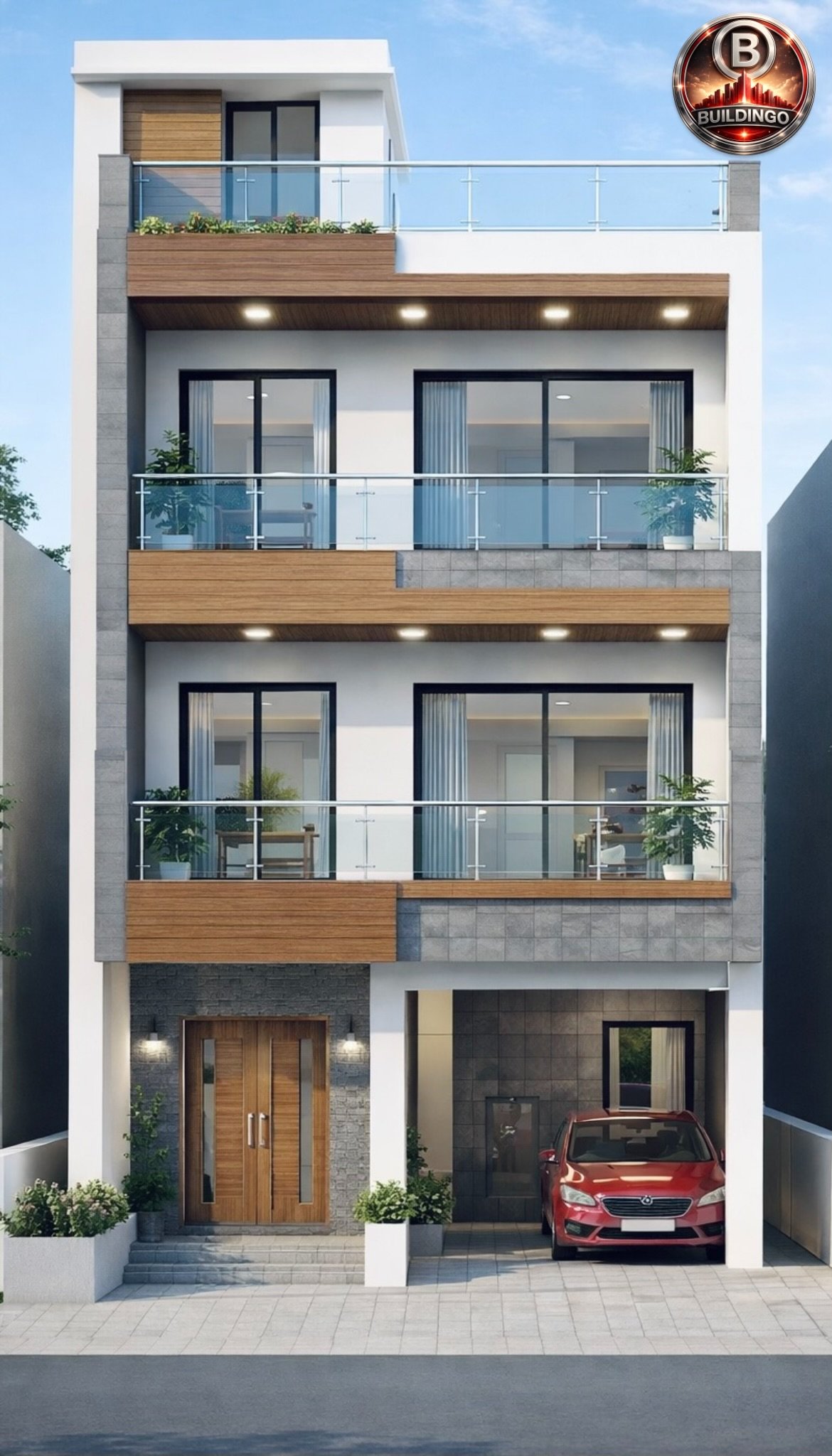
3D Front Elevation – Structural Compatibility
The G+2 elevation design includes:
- Glass balcony railing
- Controlled cantilever projection
- Vertical alignment of columns
- Symmetrical façade balance
Important:
No unsafe long cantilevers are provided.
Balcony projection is structurally safe within beam capacity.
Elevation respects structural grid — not random decoration.
Why This 15×25 House Plan Is Ideal for Today’s Scenario
Modern urban needs:
- Small land footprint
- Vertical construction
- Rental potential
- Affordable construction
- Future expansion ready
This design fulfills all.
Cost Efficiency Analysis
Uniform 10″x10″ structural members:
- Reduce shuttering complexity
- Lower labor confusion
- Minimize reinforcement waste
- Speed up construction
Pile foundation avoids expensive rework due to settlement.
5. What reinforcement details are used in this 15×25 house structural design?
The structural concept includes 4 main reinforcement bars of 10 mm to 12 mm diameter in each column, with stirrups spaced at 6 inches center to center. Beams use 10 mm main steel reinforcement with similar spacing for stirrups. The slab includes 10 mm main steel and 10 mm distribution steel placed at 6 inch spacing. This reinforcement strategy provides strength, stability, and long-term performance for a G+2 building.
Load Transfer Simplified
- Slab load
- Beam
- Column
- Pile
- Soil
Clear vertical load transfer reduces:
- Cracks
- Settlement
- Beam failure
- Column overloading
Suitable For:
- Small urban plots
- Rental investment
- CEO-level compact homes
- First-time home builders
- Budget house construction
Safety & Code Consideration
This design suits:
- Normal soil conditions
- Standard residential load
- G+2 building height
Final structural design should be reviewed according to:
- Local building by-laws
- Seismic zone
- Soil test report
6. What is the ideal wall thickness for a small plot house?
In this design, exterior walls are 10 inches thick to ensure structural rigidity, insulation, and durability. Interior partition walls are 5 inches thick to save space and reduce unnecessary dead load. This combination provides both structural safety and efficient space utilization in compact urban homes.
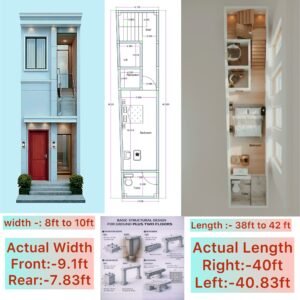
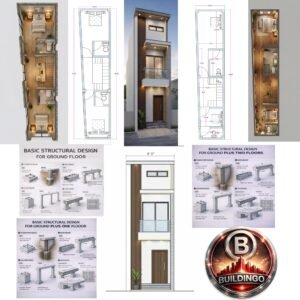
What You Get in ₹99 Combo at Buildingo.in
✔ High Resolution 2D floor plan
✔ Realistic 3D Floor Plan
✔ Modern G+2 Front Elevation
✔ Basic Structural Concept
Free preview available.
Full files unlocked after ₹99 payment.
 3D elevation + basic structural design." width="487" height="315" />
Final Conclusion
Is a 1 BHK layout practical in a 15×25 house plan?
Yes, a well-designed 1 BHK layout fits comfortably within a 15×25 plot when space planning is optimized. This design includes a 10×9 bedroom, 8×11 drawing room, compact kitchen, dining space, toilet, and staircase core. Proper furniture layout shown in the 3D floor plan ensures the house does not feel congested despite limited dimensions.
Building on a compact 15×25 plot (actual 16.5×24–26 ft) is not a limitation — it is an engineering challenge.
With:
- 8 well-placed columns
- 15 ft deep pile foundation
- 10″x10″ uniform structural members
- Proper beam alignment
- 4–5 inch slab thickness
- Balanced reinforcement
- Controlled elevation projection
This design ensures:
✔ Structural safety
✔ Cost efficiency
✔ Modern appearance
✔ Future expandability
✔ Functional comfort
If you are planning construction on a small urban plot in India, this 15×25 G+2 house plan is a technically sound and economically viable solution.
Download now from Buildingo.in and start building smart.
इस ब्लॉग का हिंदी संस्करण पढ़ने के लिए यहाँ क्लिक करें।
Follow Us On Youtube
Follow Us On Facebook
Buildingo Blog